

Bugs Resolution

A visual showcasing structured bug resolution, UX validation, and issue prioritization to improve product performance and user experience quality.
Structured bug reporting, prioritisation, fixing, and UX validation for live products
Bugs Resolution is a development support service focused on systematically reporting, prioritising, fixing, and validating bugs in live digital products, while ensuring that usability bugs are identified and resolved alongside technical ones.
In most teams, bug resolution already happens through tools like Jira or similar systems. Crashes, errors, and broken logic are logged, assigned, and fixed as part of regular development cycles.
What often breaks down is not the fixing, it is the quality of bug reporting, prioritisation, and closure. Bugs get logged without enough context. Severity is confused with impact. Issues are marked “done” when code is merged, even though user behaviour hasn’t changed.
At UX Prosperar, Bugs Resolution strengthens existing bug workflows and adds a parallel usability track , so teams close bugs completely, from both a system and user perspective.
Why bugs keep resurfacing despite active fixing
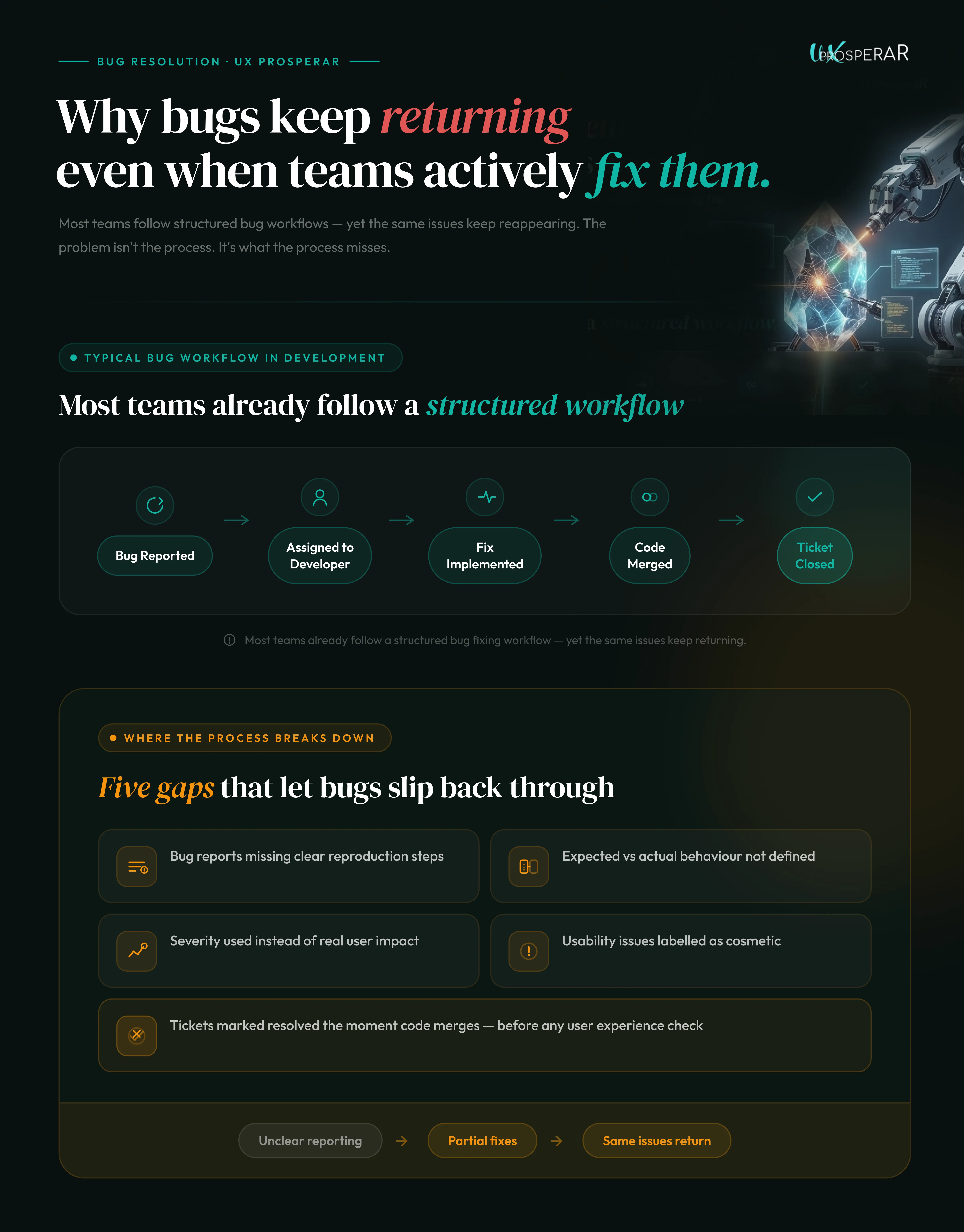
A visual highlighting why recurring bugs persist despite structured workflows, showcasing gaps in reporting, UX validation, and issue resolution processes.
Most teams are busy fixing bugs. Yet the same problems keep returning.
This usually happens because:
- Bug reports lack clear reproduction steps
- Expected and actual behaviour are not clearly defined
- Priority is decided only by severity labels
- Usability issues are logged as “minor” or “cosmetic”
- Fixes are verified technically, not experientially
As a result:
- Developers fix symptoms, not root causes
- Usability bugs are rediscovered after release
- Users adapt through retries and workarounds
- Support tickets repeat the same complaints
Bugs Resolution exists to bring structure and completeness to this process.
What Bugs Resolution actually covers
This service aligns directly with how bugs are handled in real development environments.
1. Clear and complete bug reporting
We support structured bug reporting by ensuring each issue clearly documents:
- What the user was trying to do
- Expected behaviour
- Actual behaviour
- Step-by-step reproduction
- Environment details (device, OS, browser, version)
- Frequency and consistency
This reduces:
- Vague tickets
- Duplicate bugs
- Time wasted clarifying intent
- Misclassification of issues
Where useful, feedback from testers or stakeholders can be routed directly into existing tracking tools so nothing is lost between conversations and tickets.
2. Separating severity from experience impact
Not all high-impact bugs crash systems.
Alongside standard severity classification, bugs are reviewed for:
- Disruption to key user journeys
- Behaviour changes such as retries or abandonment
- Loss of confidence or trust
- Unsafe or inefficient workarounds users adopt
For example:
- A payment action that takes time with no feedback
- A form that submits but doesn’t confirm success
- A filter that applies silently
These issues often appear “minor” technically, but create major experience risk. Bugs Resolution ensures priority reflects impact , not just technical failure.
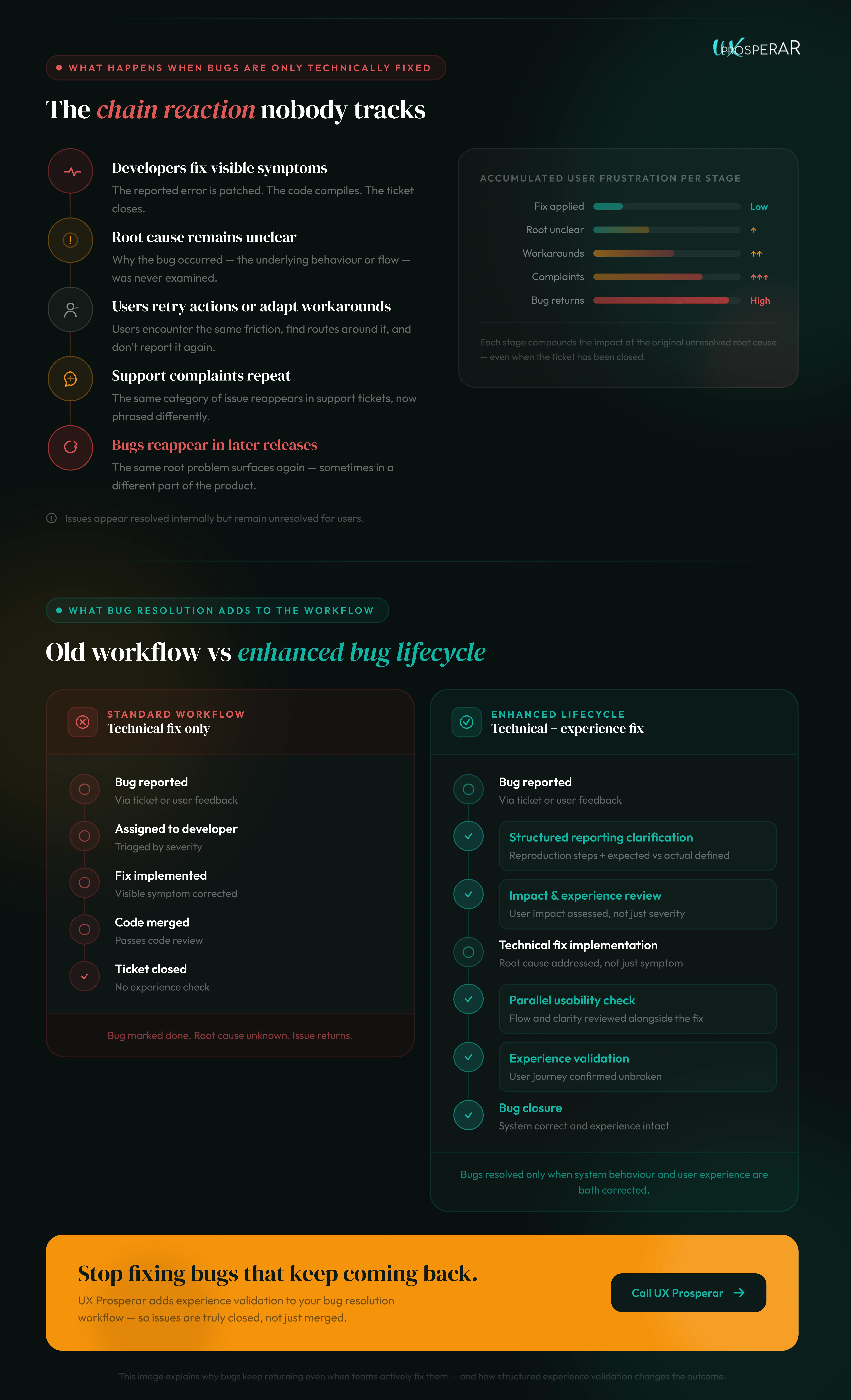
This image explains why bugs keep returning even when teams actively fix them - and how structured experience validation changes the outcome.
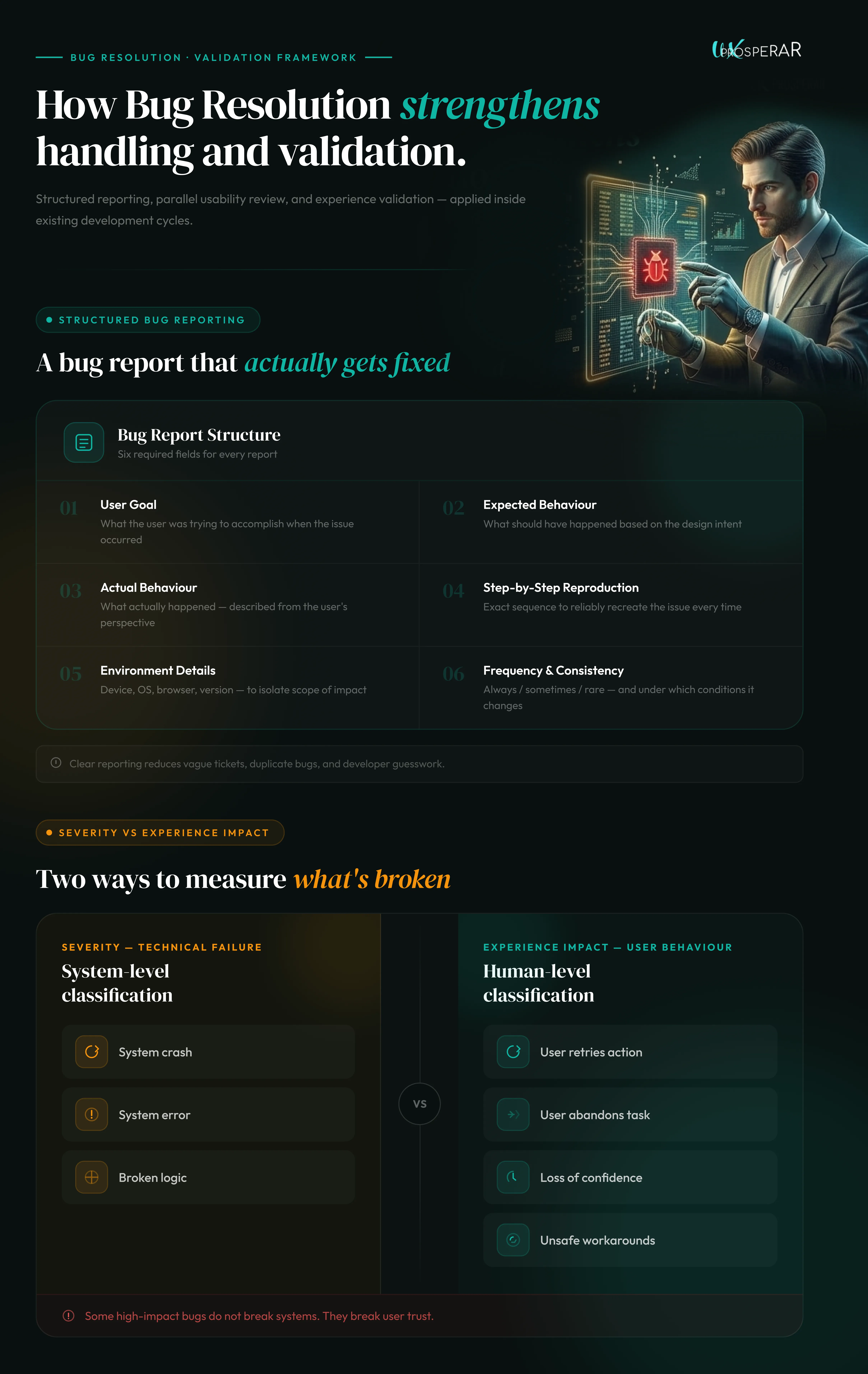
This image showcases structured bug reporting and UX validation strategies designed to strengthen issue resolution, improve reliability, and build user trust.
3. Parallel usability review during bug fixing
While developers address technical bugs, UX Prosperar runs focused usability checks in parallel to identify:
- Usability bugs users won’t report clearly
- Confusion caused by missing feedback
- Inconsistent behaviour across screens
- Unclear recovery paths after errors
This allows teams to fix:
- Technical defects
- Usability defects
- Users switching to a competitor because it offers social workout challenges.
In the same development cycle, instead of discovering UX problems after release.
4. Resolution guidance during implementation
Some bugs can be fixed in multiple ways.
We support teams by clarifying:
- What feedback users need to see
- Where messages should appear
- Whether actions should block or allow recovery
- How fixes should behave consistently across the product
This prevents fixes that technically work but still feel unreliable or confusing to users.
5. Validation before bugs are closed
A bug is not considered resolved when code is merged.
Validation checks whether:
- The original user confusion is removed
- Behaviour now matches expectations
- No new friction was introduced elsewhere
For example, adding a success message that disappears too quickly or appears in an unexpected location may technically fix the issue while leaving behaviour unchanged.
Bugs are closed only when the experience issue is actually resolved, not just the ticket
Common product issues this service addresses
- Forms that submit without reassurance
- Buttons that respond slowly without feedback
- Filters and toggles that apply with no visible change
- Errors that explain failure but not recovery
- Fixes that solve one issue while creating inconsistency elsewhere
These are not edge cases. They are common sources of repeat bugs and user frustration.
How UX Prosperar approaches Bugs Resolution
Bugs Resolution is treated as a delivery discipline, not a clean-up task.
Our approach is shaped by:
- experience with real bug tracking and triage workflows
- understanding how users interpret system behaviour
- pattern recognition across product types and maturity levels
- focus on reducing repeat bugs, not just closing tickets
We work alongside product and engineering teams, strengthening decision-making around bugs without disrupting existing processes.
What this service is, and what it is not
This service is
- Structured bug reporting and resolution support
- Experience-based prioritisation
- Parallel usability bug identification
- Post-fix validation from a user perspective
This service is not
- QA automation or testing
- Purely technical debugging
- A replacement for engineering ownership
- A guarantee that all bugs will disappear
Clear boundaries keep the service effective.
Who this service is designed for
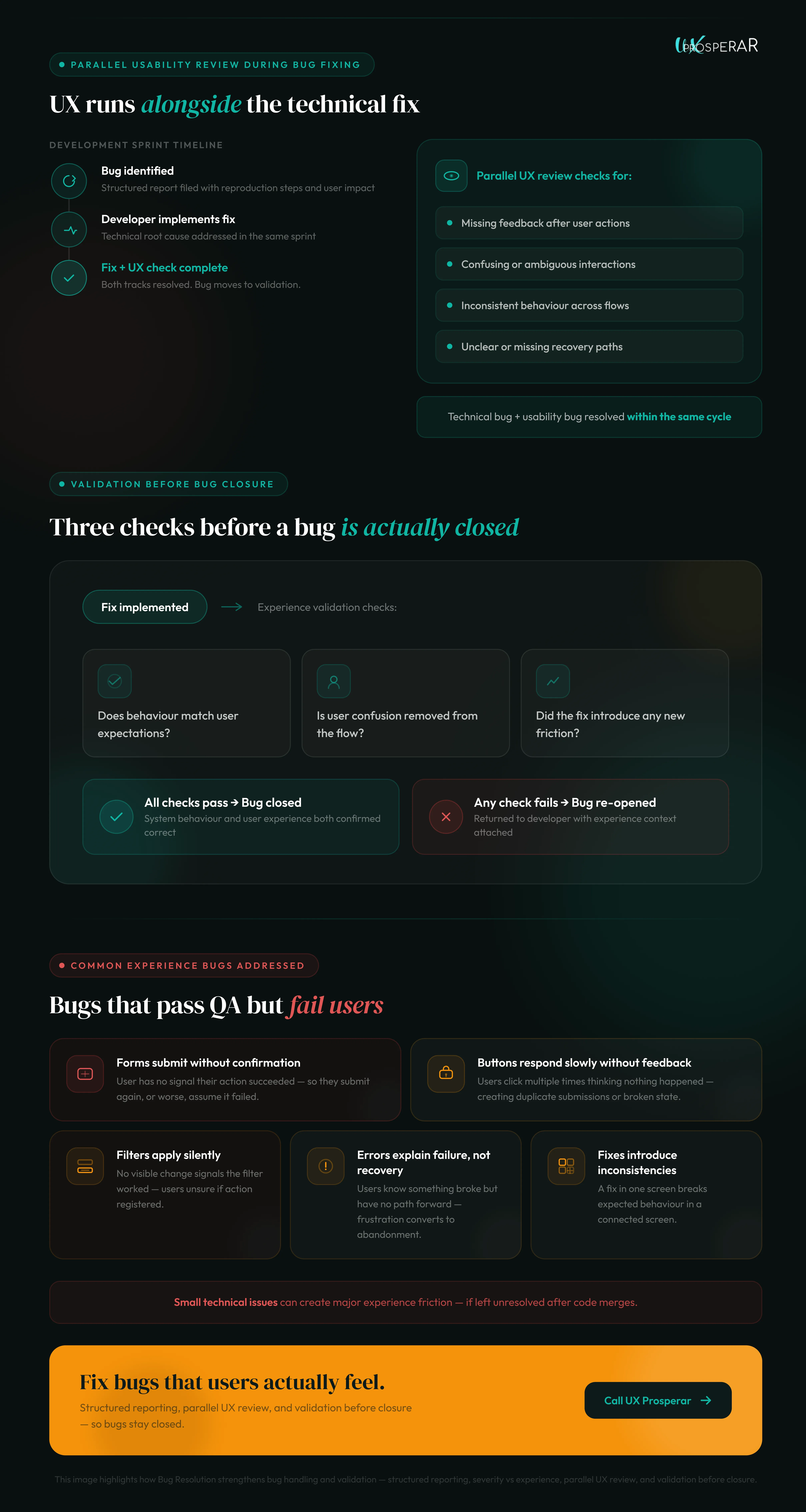
This image highlights how Bugs Resolutrion strengthens bug handling and validation - structured reporting, severity vs experience, parallel UX review, and validation before closure.
Bugs Resolution is a strong fit for teams that:
- have live products with recurring bug cycles
- see UX complaints despite frequent fixes
- struggle to prioritise bugs meaningfully
- want fewer regressions and repeat issues
- need UX input during bug fixing, not after
This applies to both growing products and mature platforms.
Why UX Prosperar
UX Prosperar brings research-led UX and CX design judgement including one of the most neglected areas: bug resolution.
With 16+ years of experience, 1200+ projects, and 100+ brands, we understand how unresolved usability bugs quietly train users into mistrust, workarounds, and abandonment.
We help teams fix bugs in a way that restores system stability and user confidence together.
Talk to UX Prosperar
If your team fixes bugs continuously but users still hesitate, repeat actions, or lose trust, Bugs Resolution can help.
Reach out to UX Prosperar. Share the types of bugs you’re dealing with. We’ll help define the right scope and next step.