

Copy Testing Study
This image showcases a Copy Testing Study focused on turning confusion into confident clicks through clarity, trust, SEO analysis, and user intent optimization.
What this service actually solves
Copy Testing Study exists to solve a very specific problem.
Your product works. The UI looks fine. The flow makes sense on paper.
Yet users hesitate, misread, abandon, or feel unsure.
When that happens, teams usually blame:
- UX design
- Pricing
- Onboarding
- User attention span
- Or the user themselves
- But many times the real issue is simpler.
- Users do not understand the label.
- They do not trust what happens next.
- They interpret a phrase differently than you intended.
- They miss the message entirely.
This service helps you find the real reason, by observing users and listening to how they interpret your language in context.
What copy testing is in UX terms
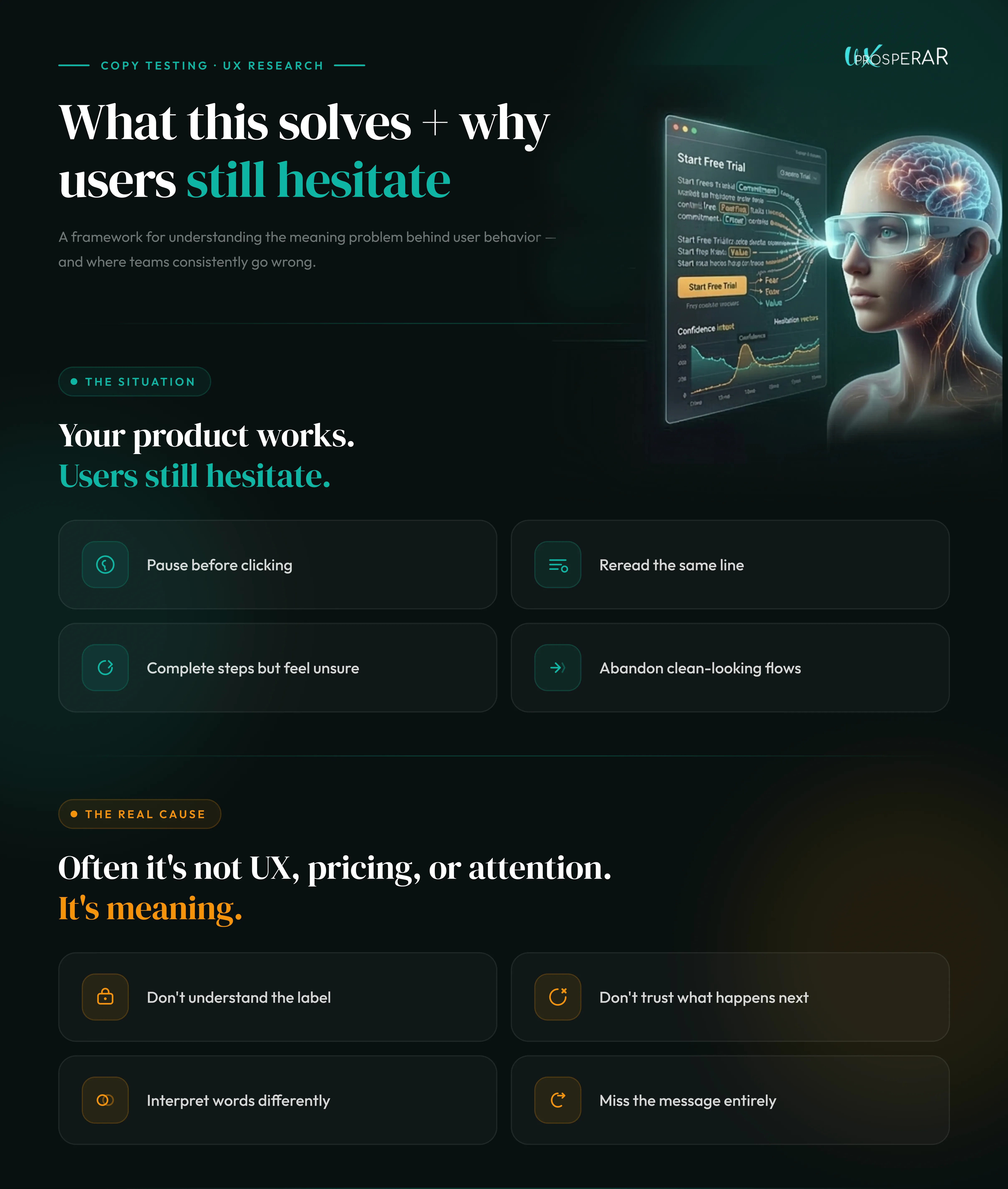
This image showcases a UX copy testing framework that identifies why users hesitate, highlighting unclear messaging, trust gaps, and meaning-driven decisions.
A UX copy testing study explores why users struggle or succeed with website or app language by: Watching them attempt tasks Asking simple, direct questions Analysing what they say, what they do, and where they hesitate
This reveals deeper meaning than numbers alone, because you learn the why behind the behaviour. You see comprehension, reactions, motivations, and the words users naturally use.
What copy problems look like in real products
Copy issues rarely show up as “bad writing”.
They show up as:
- Users pausing before clicking obvious buttons
- Users rereading the same line twice
- Users completing steps but feeling unsure if it worked
- Users abandoning flows that look visually clean
- Support tickets repeating the same misunderstanding
- Sales calls explaining what the interface already says
Where teams usually get it wrong
Mistake 1: Assuming users read copy with the same intent as the team
Teams write copy based on system logic.
Users read copy based on risk.
Example
A button says “Confirm”.
The team means “move to the next step”.
Users read it as “this action cannot be undone”.
They hesitate, not because they lack intent, but because they lack certainty.
Mistake 2: Treating hesitation as a design problem instead of a meaning problem
Teams redesign screens when users hesitate.
But if the meaning is unclear, better visuals do not fix it.
Example
A pricing page looks neat but users still choose the cheapest plan.
The team assumes price sensitivity.
Copy testing shows users cannot explain what improves after upgrading.
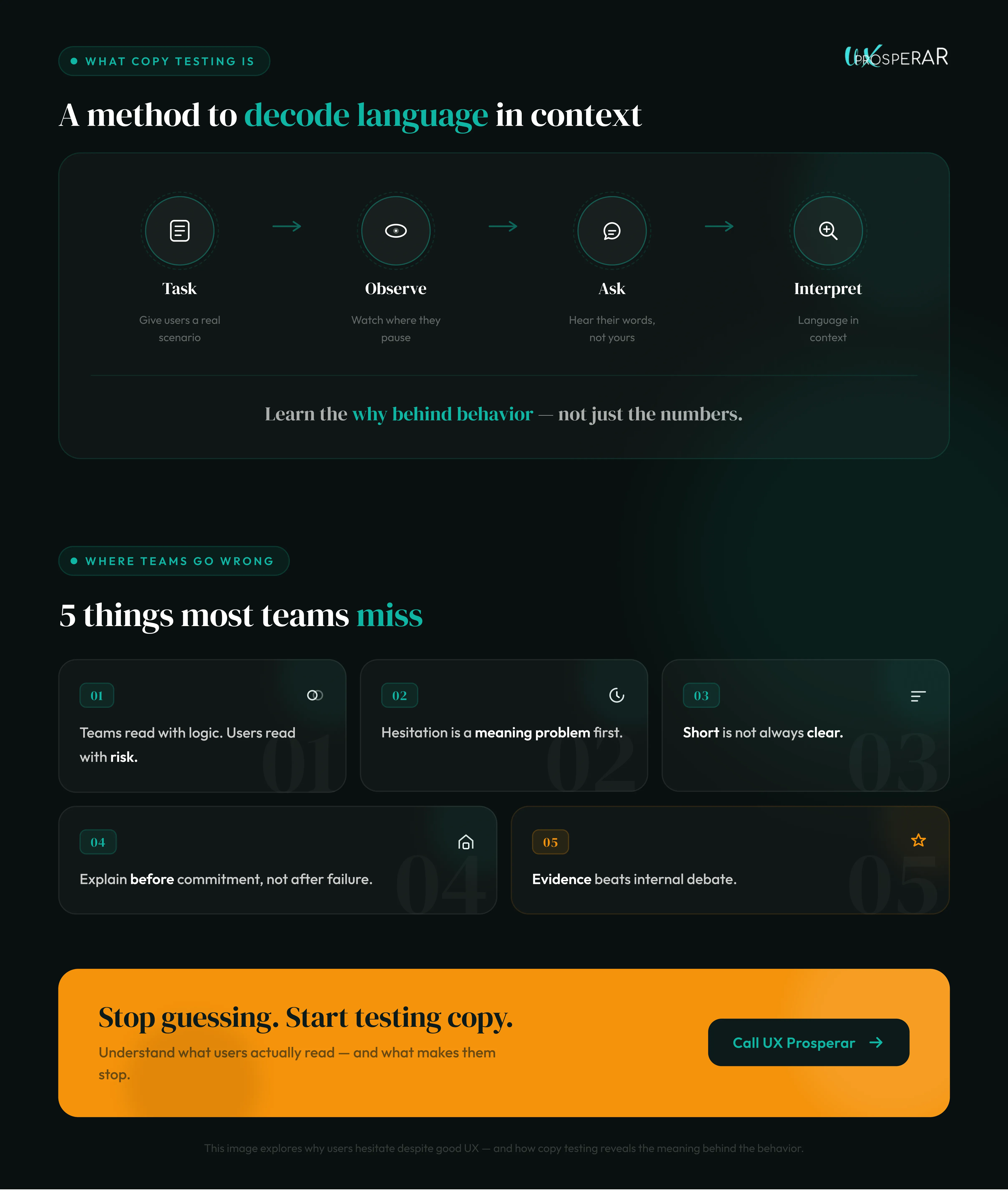
This image explores why users hesitate despite good UX - and how copy testing reveals the meaning behind the behavior.
Mistake 3: Believing fewer words always means better UX
Short copy is not always clear copy.
Example
“Connect your account” with no context makes users fear what you will access.
Vague language creates more anxiety than a slightly longer explanation.
Mistake 4: Explaining after failure instead of commitment
Many products explain things after the user is already confused.
Example
“Transaction failed” with no reassurance makes users worry money was deducted.
Even if support later clarifies, trust already broke.
Mistake 5: Replacing evidence with internal debate
Copy decisions often get stuck in opinions.
That is where UX Prosperar steps in as the external lens.
We replace debate with user evidence.
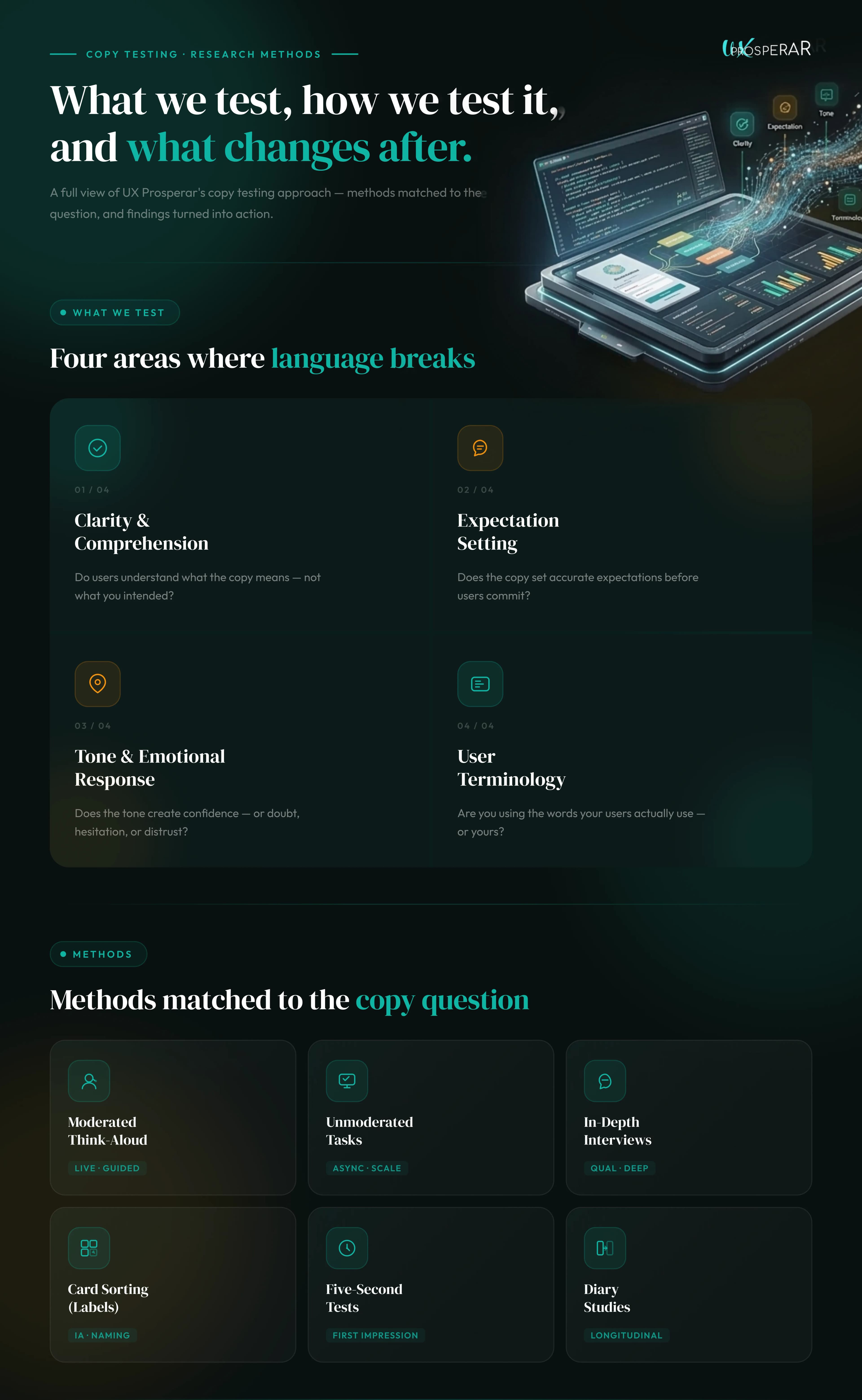
This image showcases UX copy testing methods that evaluate clarity, tone, terminology, and user understanding to improve communication and decision-making.
What UX Prosperar tests
We test four themes because they map to real user outcomes.
Clarity and comprehension
Do users understand what a label or sentence means without guessing.
Expectation setting
Do users know what will happen after they click.
Tone and emotional response
Does the copy create trust, pressure, friction, or frustration.
User terminology
What words users naturally use, so your interface matches their language instead of internal language.
Methods we use depending on the copy question
We do not force one method for every problem.
We match the method to the risk and context.
Moderated usability tests with think aloud
Users complete tasks while explaining what they think is happening. This is one of the fastest ways to catch misinterpretation.
Unmoderated copy testing tasks
Useful when you need broader coverage across variations, flows, or screens.
Interviews
Best when you need deeper understanding of motivations, trust concerns, and why a phrase feels risky or unclear.
Card sorting for labels and terminology
Useful when users cannot find things because category names and labels do not match their mental model. It helps you learn how users group and name content naturally.
Five second tests
Useful for first impressions and message recall. What users take away in five seconds is often what they act on.
Diary studies
Useful when copy impacts repeated usage over time.
For example, ongoing notifications, progress messaging, or recurring service journeys.
We use the method that reveals the answer with the least noise.
How the study runs
This is how UX Prosperar typically runs a copy testing study without overcomplicating it.
Step 1: Define the copy questions
- We get specific.
- For example:
- Is this error message clear
- Do users understand this plan difference
- Does this CTA feel safe to click
- Are we using words users would use
Step 2: Recruit the right users
We recruit participants who match your real audience.
Not generic testers.
Step 3: Build realistic tasks and scenarios
Copy only makes sense inside action.
We create tasks that mirror real user goals.
Step 4: Run the sessions
Remote or in-person depending on scope.
We capture what users do, what they say, where they pause, and what they assume.
Step 5: Analyse and theme findings
We code transcripts, identify patterns, and group issues into themes.
Clarity issues, trust issues, tone issues, terminology mismatches, expectation gaps.
Step 6: Turn findings into priorities
We translate themes into practical next steps that teams can act on.
We keep it decision focused and avoid rigid promises.
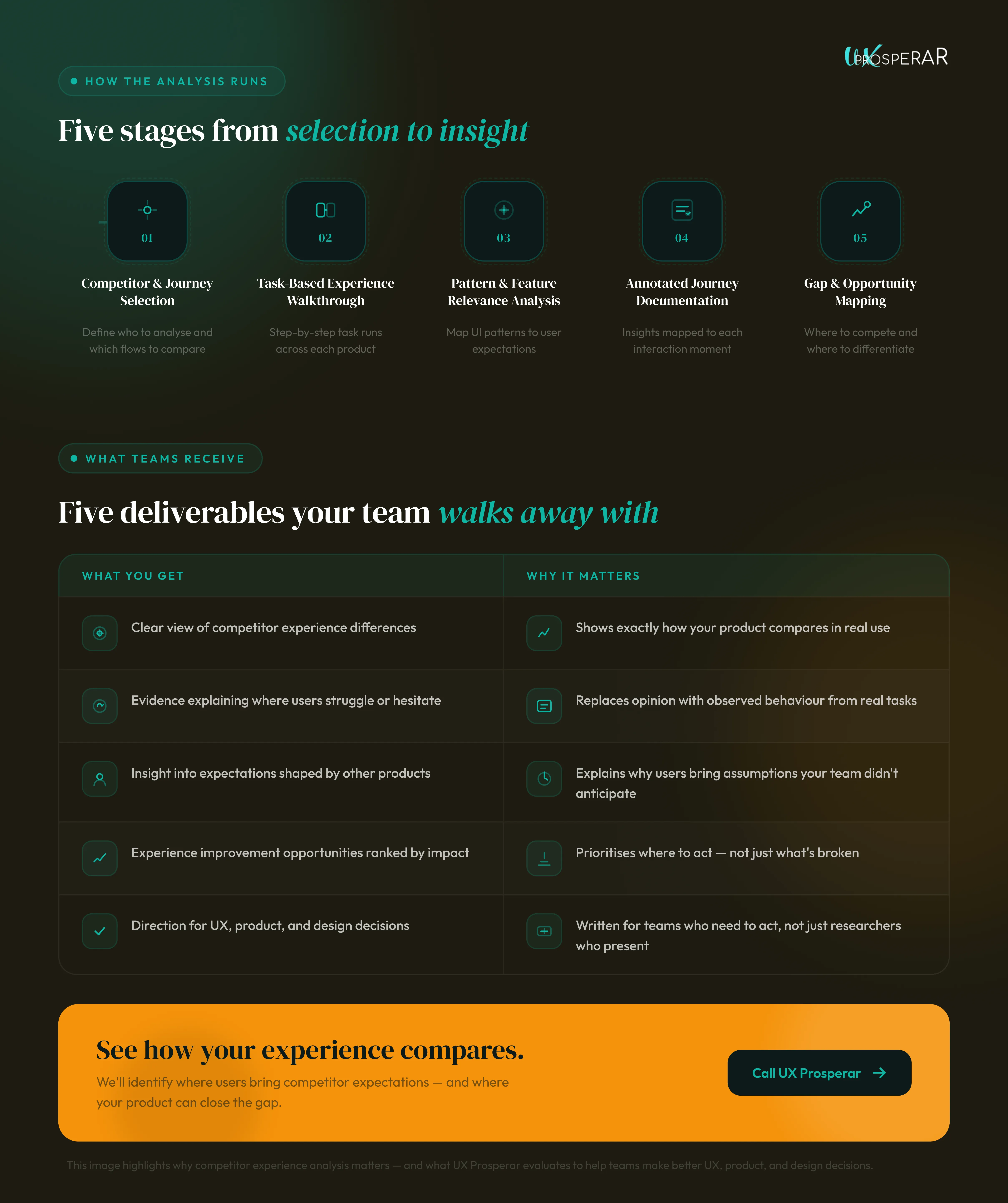
This image highlights why competitor experience analysis matters - and what UX Prosperar evaluates to help teams make better UX, product, and design decisions.
Example questions we use during copy testing
These questions uncover misunderstanding fast.
- What does this button do
- What were you expecting to happen when you clicked that
- What does this plan include in your words
- What feels unclear or missing here
- Does this feel complete or overwhelming
- What word would you use to describe this feature
- If you had to explain this screen to a friend, what would you say
What changes after this study
Teams typically gain clarity on:
Which words cause hesitation or drop off
Which labels are being misread
Where copy creates false expectations
Which messages break trust during failure moments
What user language to adopt for clearer terminology
What to fix first and what can wait
Often, the biggest win is not “better writing.” It is removing the one sentence that is quietly breaking the flow.
Where copy testing delivers the most value
Sign up and onboarding flows Pricing and plan selection
Checkout and payment steps
Complex forms
Permission and data access prompts
Error and retry states
Any step where users fear losing money, time, or control
Why UX Prosperar
UX Prosperar is a research led and strategic UX and CX design agency based in Dubai. We specialise in catching silent experience failures that teams miss because they sit between product, design, and content.
With 16 plus years of research experience, 1200 plus projects completed, 100 plus brands served, and 4 plus awards, UX Prosperar brings pattern recognition and clarity to decisions that often get reduced to opinions.
Call UX Prosperar
If users are hesitating, misunderstanding, or dropping off in key flows, a Copy Testing Study will show you what your words are doing to the experience.
Call UX Prosperar and tell us which flow feels fragile. We will suggest the right scope and next step