

Ongoing Development Support
This image showcases Ongoing Development Support, combining continuous web and app development with UX and CX alignment for scalable digital growth.
Continuous web and app development with built-in UX and CX alignment
Ongoing Development Support is a continuous product development service for teams that are actively building, extending, and maintaining digital products over time.
This service is designed for products that don’t stop at launch. Websites evolve. Web applications gain new modules. Mobile apps go through frequent releases. Features are added, flows are adjusted, integrations change, and priorities shift quarter by quarter.
Ongoing Development Support exists to help teams keep building without losing structure, clarity, or consistency, while ensuring that UX and CX considerations are addressed as part of development, .not as a separate exercise
At UX Prosperar, this service functions as both:
- ongoing development and enhancement, and
- a long-term product development partnership that reduces rework and friction as products scale.
What we support through ongoing development
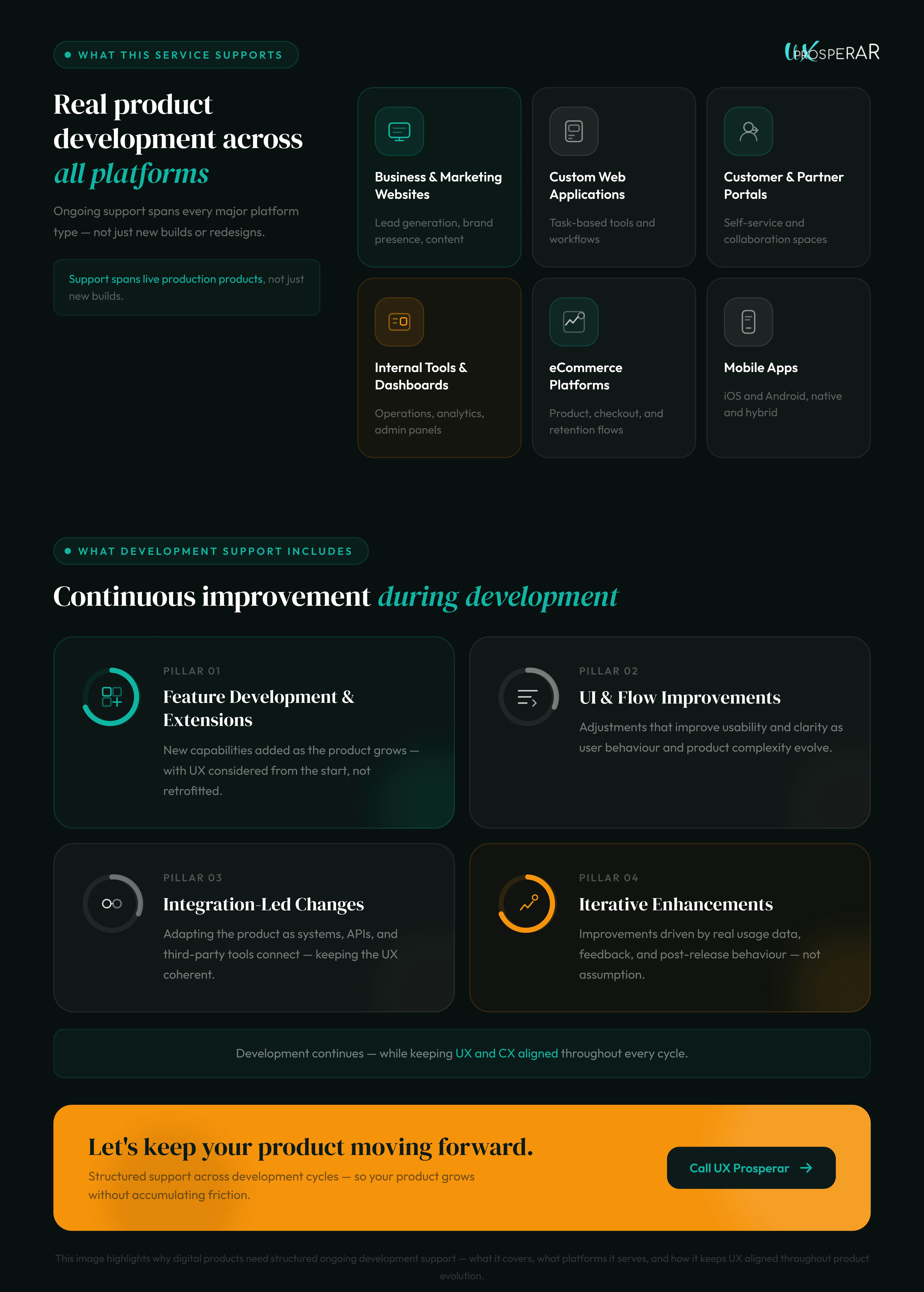
This image highlights why digital products need structured ongoing development support - what is covers, what platform it serves, and how it keeps UX aligned throughout product evaluation.
This service covers real, production-grade digital products, including:
- Business and marketing websites
- Web applications
- Custom web applications
- Customer and partner portals
- Internal tools and dashboards
- eCommerce platforms
- Mobile applications (iOS and Android)
- Multi-platform products (web + mobile)
Support spans:
- feature development and extensions
- UI and flow updates
- performance and usability improvements
- integration-led changes
- iterative enhancements based on usage and feedback
The emphasis is on building and improving, not reviewing from the sidelines.
Why ongoing development becomes risky without structure
Most long-term product issues don’t come from bad development. They come from uncoordinated growth
Common situations include:
- features added sprint by sprint without revisiting existing flows
- new screens introduced to “just fit one more requirement”
- design changes arriving mid-development without context
- developers making UX assumptions to unblock work
- analytics and tracking added after release, if at all
Each decision makes sense on its own. Together, they slowly change how users experience the product.
Over time, teams notice:
- increased support queries
- inconsistent behaviour across screens
- features that technically work but feel unreliable
- growing UX debt that’s hard to trace back
Ongoing Development Support exists to keep delivery moving while preventing these slow failures.
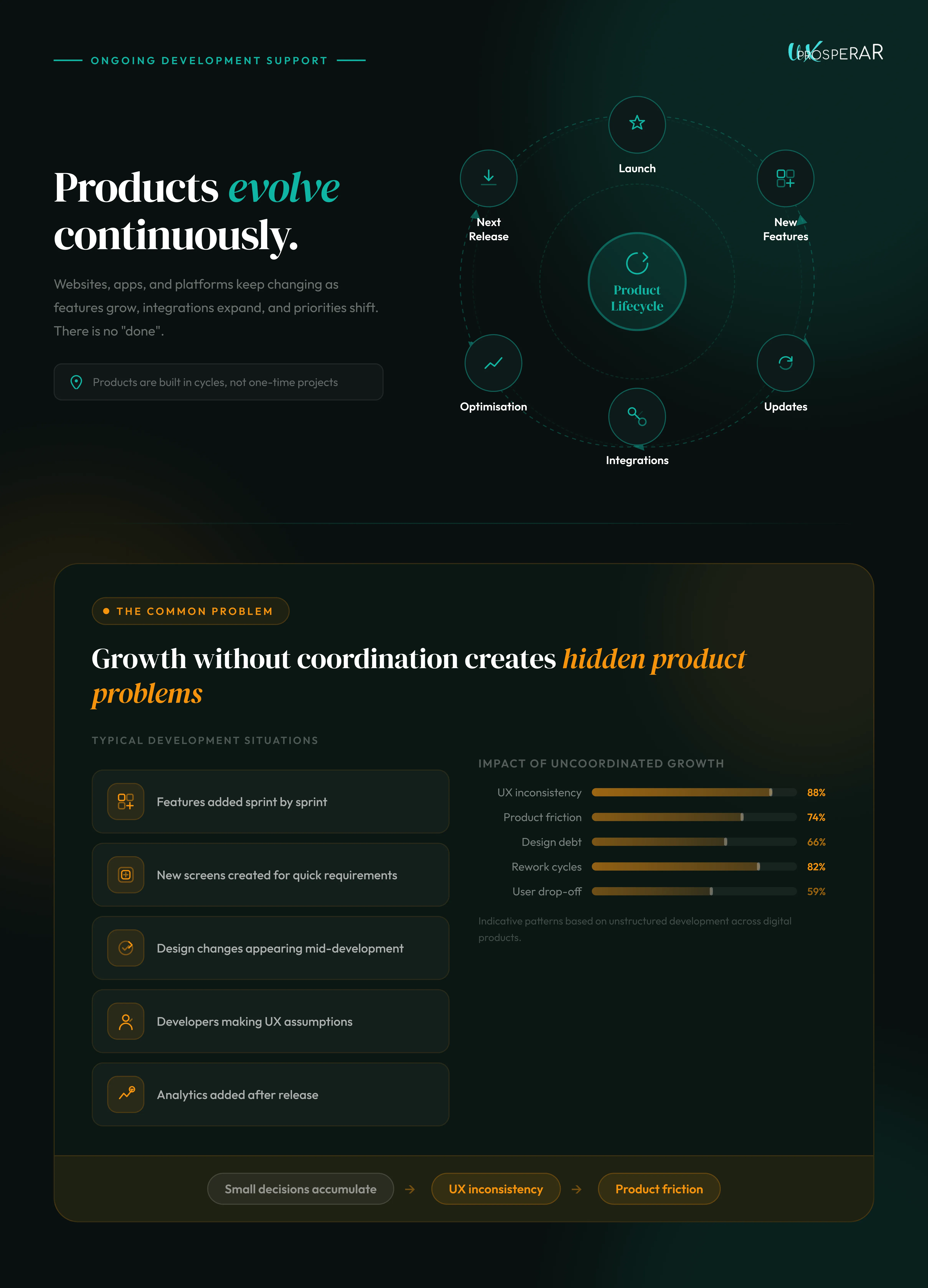
This image showcases how ongoing development support helps products evolve continuously while preventing UX inconsistency, friction, and hidden growth issues.
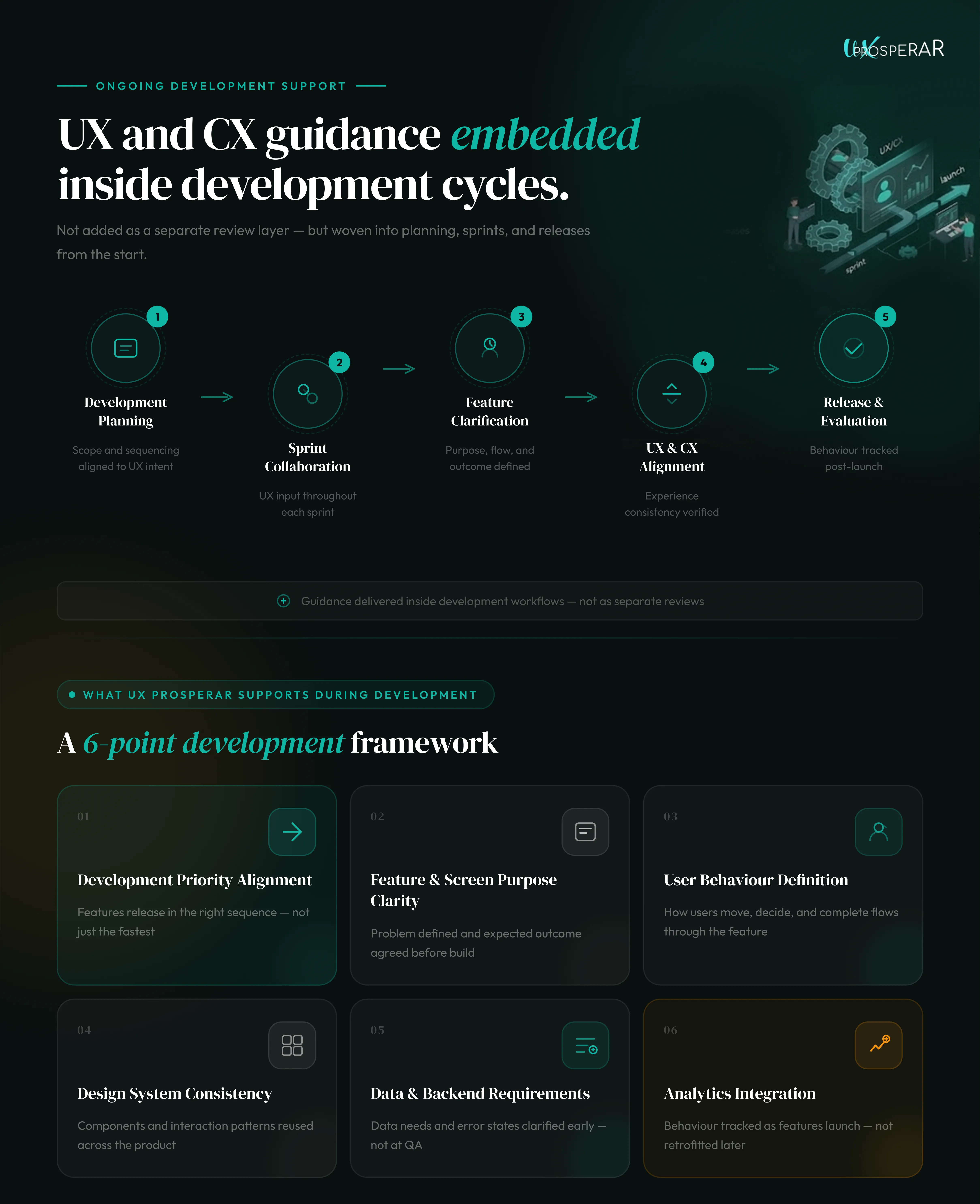
This image showcases how UX and CX guidance are embedded into development cycles to improve product clarity, consistency, and user experience.
How Ongoing Development Support works in practice
This service sits inside your development workflow, not above it.
Aligning development priorities and platform sequencing
Before and during development, we help teams stay aligned on:
- what must go live first
- which platform leads (web vs app)
- approval and release constraints
- feature dependencies across platforms
This avoids wasted effort caused by building out of sequence or redesigning flows due to late platform decisions.
Working in sync with sprint cycles
UX and CX input is aligned to:
- sprint length
- backlog planning
- release cadence
Instead of large handoffs, guidance is delivered in small, usable inputs that developers can apply immediately. This keeps momentum high and avoids late-stage corrections.
Clarifying the purpose behind each feature and screen
For every feature or screen under development, we help define:
- the user problem it solves
- the business intent behind it
- the expected outcome
When constraints appear, teams know what must be preserved . and what can be adjusted without damaging the experience
Defining expected user behaviour during development
We make explicit:
- how users are expected to move through a flow
- where they decide, pause, retry, or exit
- what signals confirm success or failure
This helps developers understand why logic and feedback matter, not just what to build.
Supporting design system usage and component reuse
Interfaces are mapped to:
- existing design system components
- shared interaction patterns
- speeds up development
- reduces one-off UI logic
- keeps behaviour consistent across teams
When new components are needed, they are defined clearly so they can scale.
Clarifying data and backend requirements early
For each screen or component, we outline:
- required data fields
- API dependencies
- empty and error states
- loading and fallback behaviour
This prevents late backend changes and fragile UX caused by missing or unclear data.
Managing changes, versions, and communication
As products evolve, clarity matters.
We help teams maintain:
- clear naming conventions
- version control for flows and screens
- early communication of updates
- consistent tagging of design changes
So development teams know what changed, where, and why, without slowing delivery.
Embedding analytics into development decisions
Tracking is defined as part of development:
- what interactions should be measured
- where drop-offs or retries matter
- how behaviour should be evaluated post-release
This ensures teams can validate real usage instead of relying on assumptions.
Everyday development situations this service supports
When a feature must ship quickly
UX input helps simplify without breaking user understanding.
When dashboards or settings screens keep growing
We help restructure logic instead of endlessly adding options.
When multiple teams work on connected flows
We maintain consistent behaviour and feedback patterns
When technical constraints appear mid-sprint
UX helps teams adapt without confusing users.
When features exist but adoption stays low
We identify whether the issue is timing, placement, or clarity.
These are development realities, not redesign triggers.
What this service is, and what it is not
This service is
- Ongoing web and app development support
- Continuous feature enhancement and extension
- UX and CX alignment embedded into delivery
- A way to reduce rework and long-term UX debt
This service is not
- A UX audit
- A redesign programme
- A fixed-scope build
- An unstructured retainer
Clear boundaries keep the service effective.
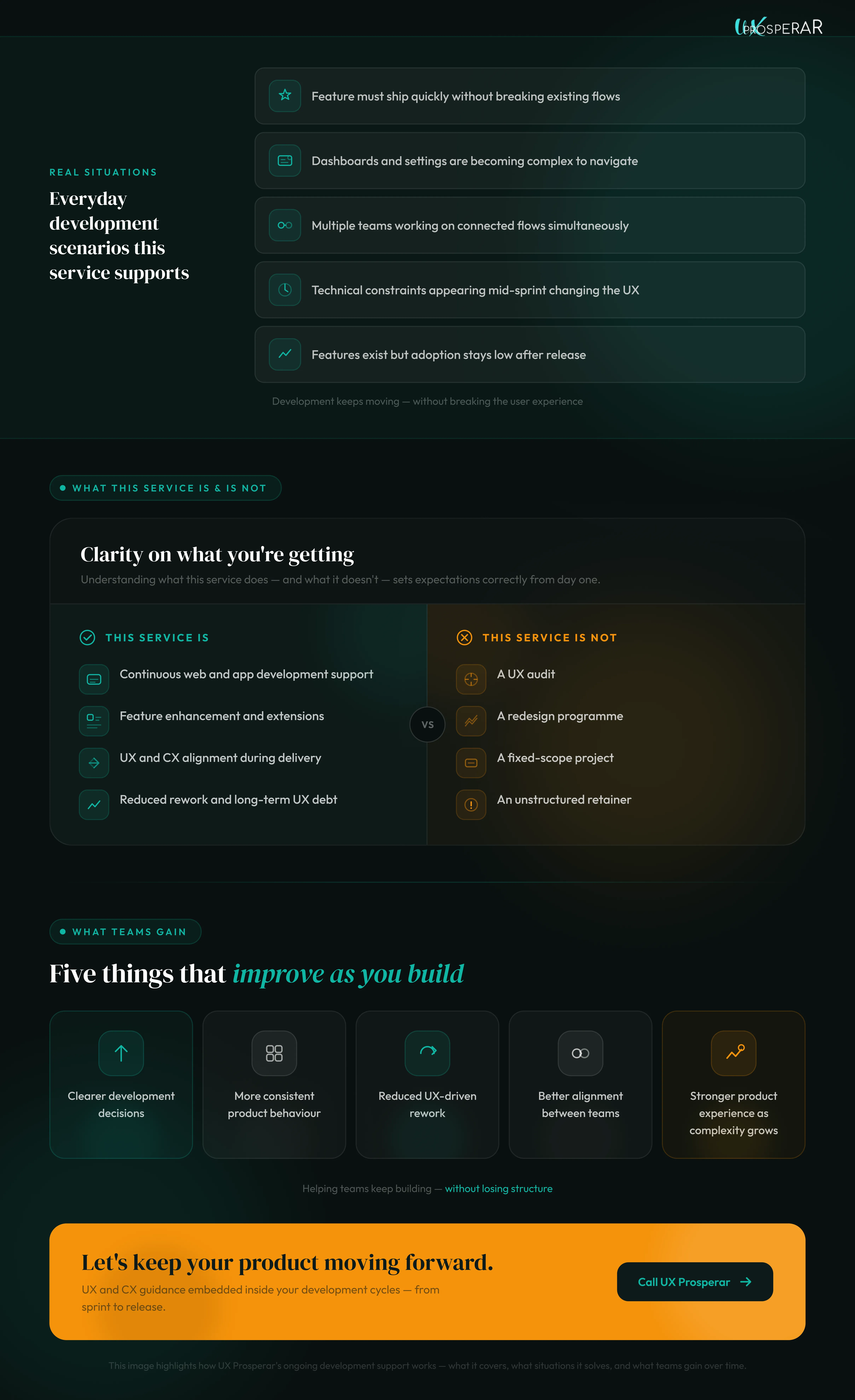
This image highlights how UX Prosperar’s ongoing development supports works - what it covers, what situation it serves, and what teams gain over time.
Who this service is for
Ongoing Development Support is a strong fit for teams that:
- have live digital products
- release features regularly
- operate across web and mobile
- want fewer UX-driven reworks
- need clarity during development, not after
This includes startups, scale-ups, and enterprise product teams.
Why UX Prosperar
UX Prosperar combines hands-on development understanding with research-led UX and CX design judgement
With 16+ years of experience, 1200+ projects, and 100+ brands, we understand how products evolve in real conditions, under timelines, constraints, and changing priorities.
Our role is to help teams keep building with confidence, ensuring that what ships continues to make sense to users as complexity grows.
Talk to UX Prosperar
If your product is actively being built, extended, or scaled, Ongoing Development Support can help you maintain structure, consistency, and clarity without slowing delivery.
Reach out to UX Prosperar. Tell us what you’re building and how your team works. We’ll help define the right level of ongoing support.