

Pricing Strategy From The User’s POV

The image represents a modern pricing strategy approach focused on improving user understanding, reducing objections about cost, and driving confident upgrades.
What this service is
Pricing Strategy From The User’s POV is a pricing research and pricing page comprehension study. It tells you three things, clearly:
- What users think is worth paying for
- What price range feels acceptable to them
- What on your pricing page is confusing, raising doubt, or killing upgrades
This is not a finance exercise. It is user perception, value mapping, and decision flow, tested with real users.
What you will be able to decide after this
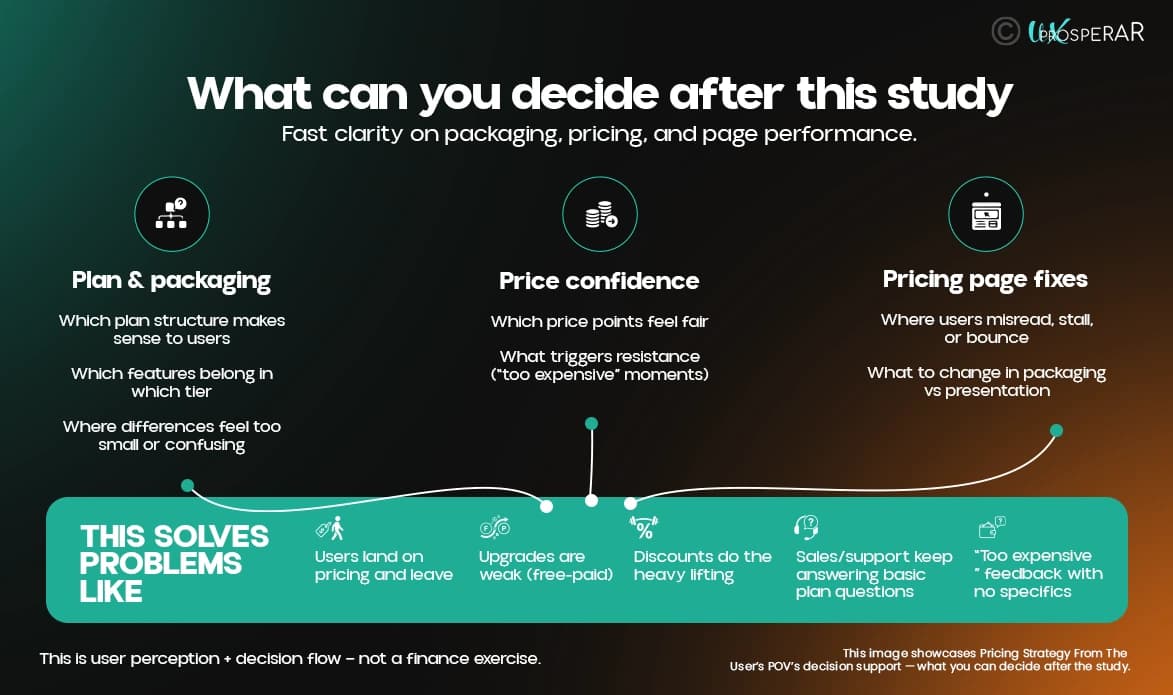
This image showcases Pricing Strategy from the user’s POV’s decision support - what you can decide after the study.
This service is built to answer real pricing decisions, fast and clearly.
You will be able to decide:
- Which plan structure makes sense to users
- Which features belong in which tier
- Which price points feel fair and which ones trigger resistance
- Where your pricing page loses users and why
- What needs to change in packaging versus what needs to change in the page presentation
If you are stuck hearing “too expensive” with no clarity on exact benefits, this is how you find out what that actually means.
Common pricing problems this service solves
If any of these are true, this service fits.
- Users land on pricing and leave quickly
- Upgrades from free to paid are weak
- Discounts are doing the heavy lifting
- Users keep asking sales or support basic plan questions
- Users say “too expensive” but cannot explain why
- Plans exist, but the differences feel small or confusing
- Feature adoption is good, but paid conversion is not
What you get out of it
No rigid promises. No vague “insights” language. You get clear decision support in a practical format.
You can expect:
- A clear view of what users think is fair and what triggers resistance.
- A Feature Value view that shows what belongs in each tier
- Price sensitivity direction from Gabor Granger style testing.
- A list of pricing page friction points that cause hesitation or drop off
- Packaging and pricing UX recommendations framed as priorities, not a giant wishlist
What we do in this service
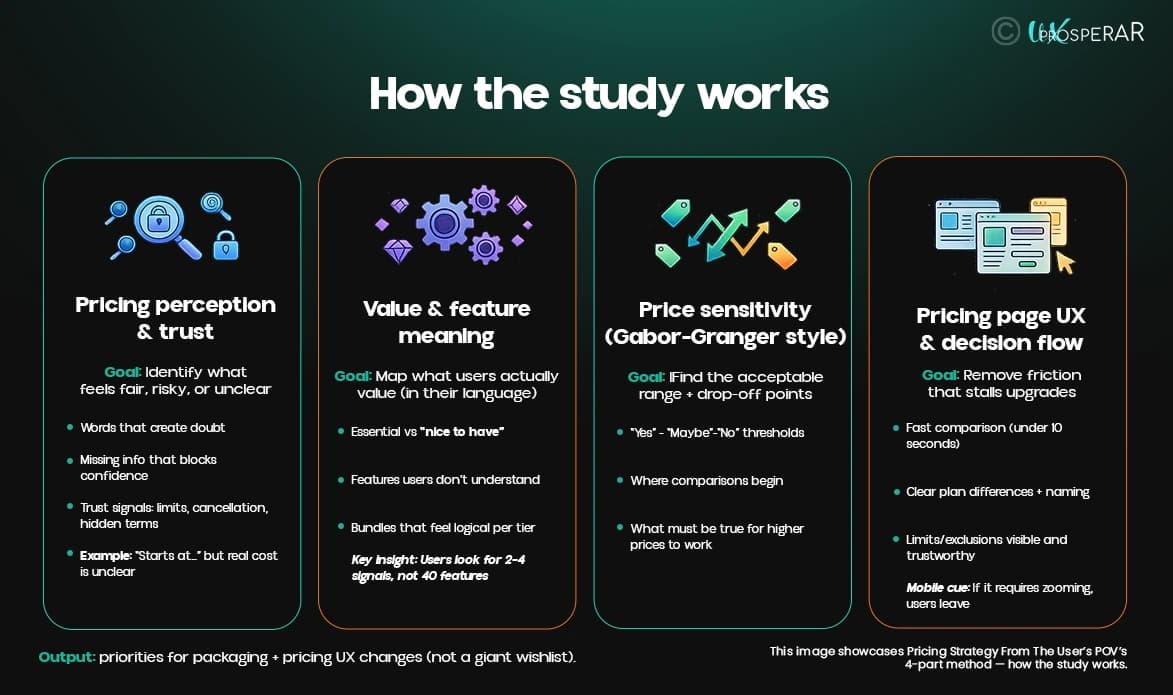
We work in four parts. Each part answers one kind of pricing question.
1. Pricing perception and trust
Goal - Find what makes users feel pricing is fair, expensive, unclear, or risky
What we look for:
- Words that create doubt
- Missing information that makes users hesitate
- Signals that affect trust, like cancellation terms, hidden limits, or vague plan names
Everyday example:
- A user sees “Starts at AED 199” but cannot tell what the real monthly cost will be.
- Duplicate bugs
- Even if AED 199 is reasonable, it feels risky because it sounds like the true price is hidden.
- Users often leave because they do not want surprises.
This is not about lowering the price. It is about removing doubt.
2. Value and feature meaning
Goal - Find what users actually value, so your Feature Value and Feature pricing make sense.
What we look for:
- Which features users see as essential
- Which features feel like extras
- Which features users do not understand at all
- Which bundle feels logical for a plan
Everyday example
- A SaaS tool lists 40 features per plan.
- Users do not read all 40.
- They look for 2 to 4 signals that matter to them, like team seats, integrations, export limits, automation, support.
If those signals are buried, users cannot justify the higher tier and upgrades stall.
So we map value in the user’s language, not internal language.
This image showcases Pricing Strategy from user’s POV’s 4-part method - how the study works.
3. Price sensitivity using Gabor Granger
Goal - Find the price range users accept and where demand drops.
How it works in plain language
- We show users a price and ask if they would buy.
- We adjust the price up or down and repeat.
This helps identify where “yes” becomes “maybe” and where it becomes “no.”
Everyday example
- A delivery subscription at AED 19 feels like an easy yes.
- At AED 39, users start comparing alternatives.
- At AED 59, many say no unless savings are very clear.
Gabor Granger helps you see those breakpoints for your audience, not for your internal guess.
4. Pricing page UX and decision flow
Goal - Fix the moments where users misread, stall, or bounce because the page is not helping them choose.
What we look for
- Can users compare plans quickly
- Do they understand the main differences in under 10 seconds
- Are the plan names clear or just marketing labels
- Does the recommended plan feel helpful or manipulative
- Are limits and exclusions clear enough to trust
Everyday example
A user is on mobile.
- If the comparison table requires zooming, they stop.
- If every plan says “Best for growing teams” they still do not know which one is for them.
- If pricing is clear but value is vague, they assume the higher plan is not worth it.
Pricing UX is often why pricing “feels expensive” even when it is not.
What we need from you to run it well
You do not need to prepare a lot, but a few inputs make it sharper.
Helpful inputs:
- Current pricing page link or draft
- Current plans, limits, and key differentiators
- Any upcoming changes you are considering
- Your target audience type and buying context
- One or two main goals, like improve upgrades, reduce discount reliance, test a new tier
Why UX Prosperar
UX Prosperar is a research-led and strategic UI/UX and CX design agency based in Dubai. We treat pricing like a user journey. We study what users see, what they believe, what they compare, and what makes them commit.
With 16+ years of experience, 1200+ projects completed, 100+ brands served, and 4+ awards, UX Prosperar brings calm rigour to pricing decisions that often get driven by opinions.
Call UX Prosperar
If your pricing page is not converting, or your plans are not upgrading the way they should, Pricing Strategy From The User’s POV will show you where value is not landing and what to change first.
Call UX Prosperar and tell us what you are selling and how your pricing works today. We will suggest the right scope and next step.