

Segmentation and Persona Mapping Study
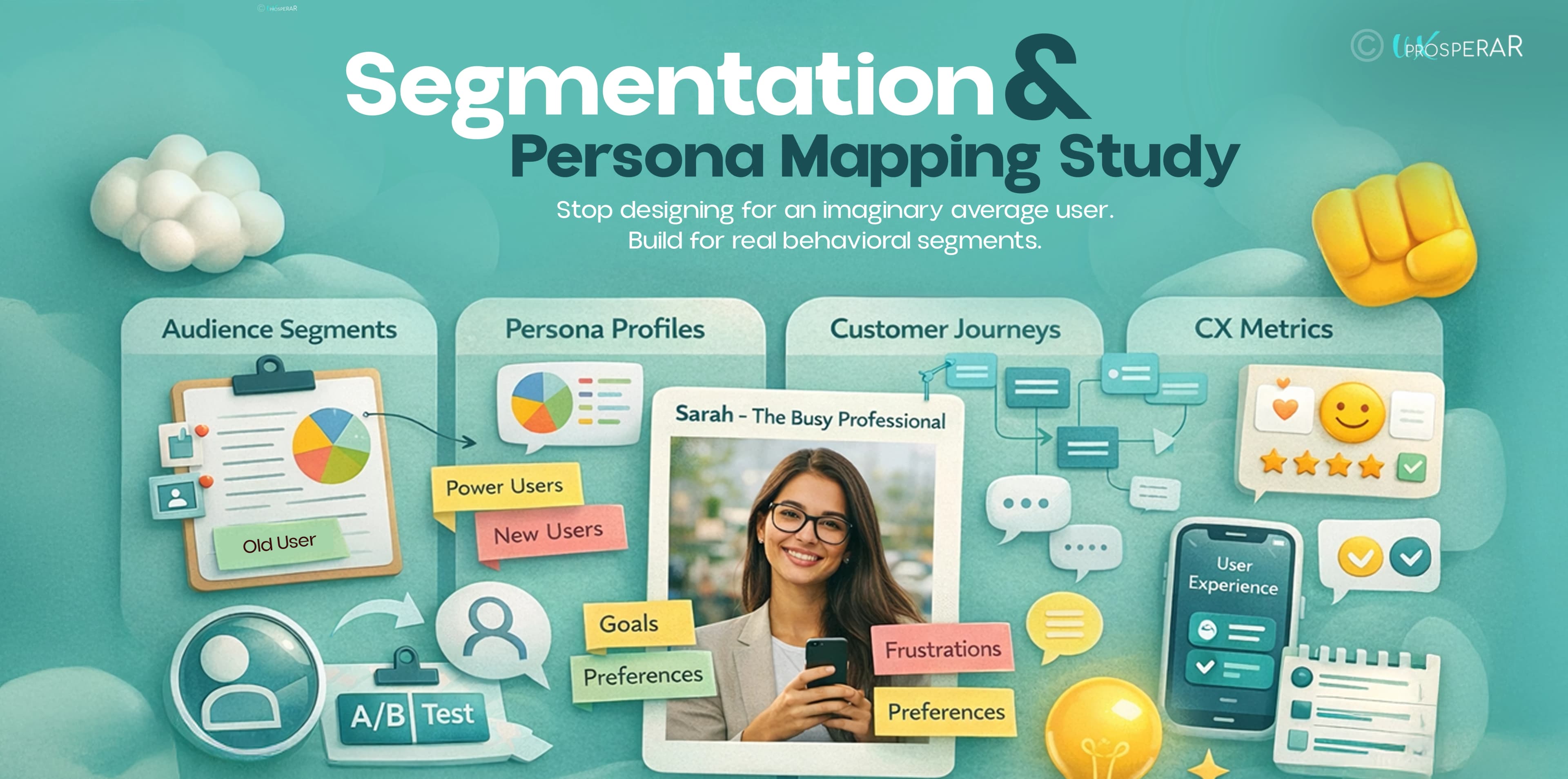
This image showcases segmentation and persona mapping strategies used to understand user behavior, improve journeys, and enhance customer experience.
What this service is
Segmentation and Persona Mapping Study helps you clearly understand who your users are, how they differ from each other, and why they behave the way they do. It replaces assumptions with evidence, so teams stop designing for an imaginary average user.
This service answers very practical questions:
- Which user groups actually exist in your audience
- How their needs and behaviour differ
- Why the same product feels easy for some users and frustrating for others
- Which users you should prioritise for design, product, and growth decisions
What you will be able to decide after this
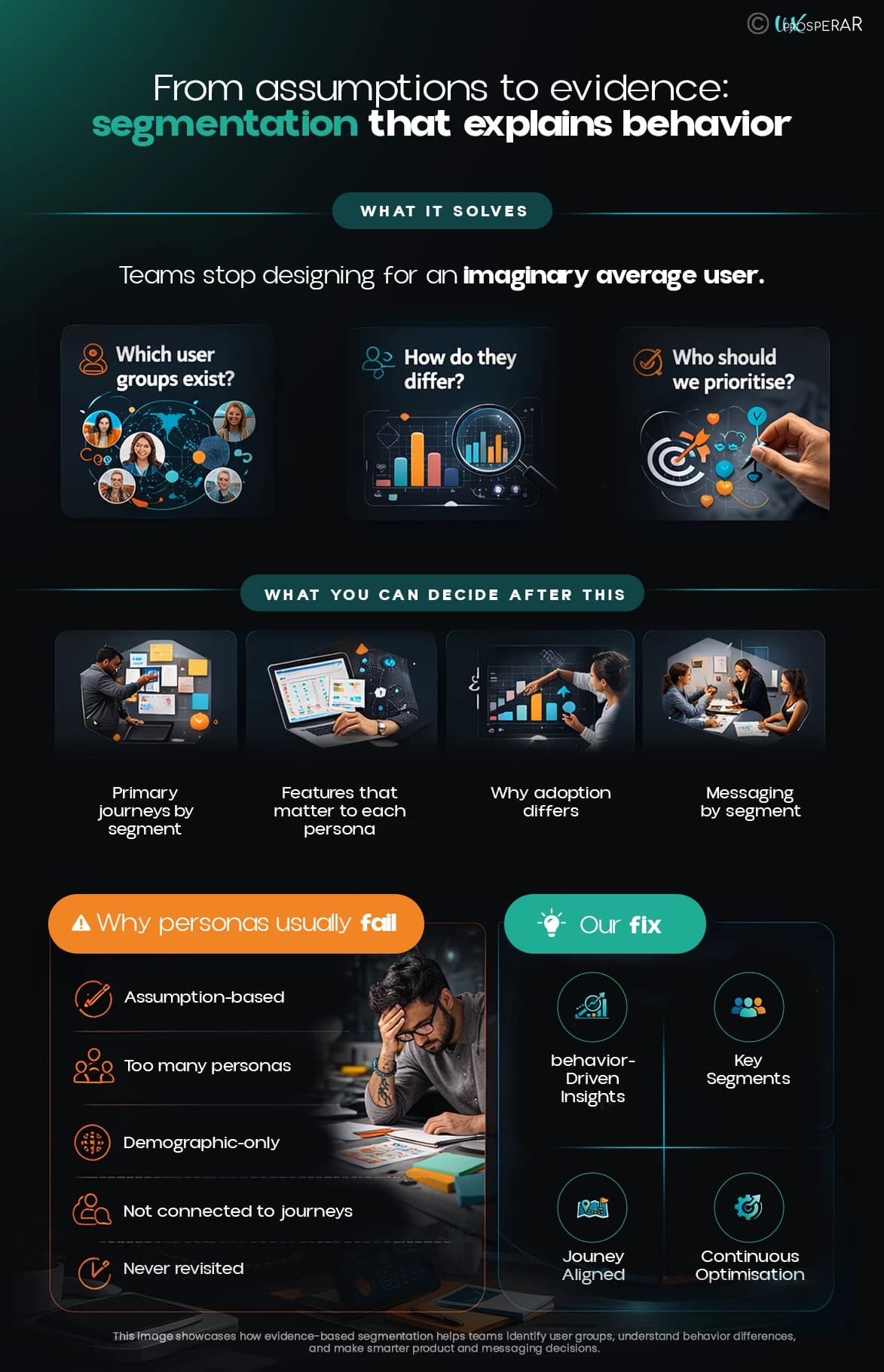
The image showcases how evidence-based segmentation helps teams identify user group, understand behaviour differences, and make smarter products and messaging decisions.
After this study, you will be able to make clearer decisions such as:
- Which user groups to design primary journeys for
- Which features matter to which personas and which do not
- Why certain users adopt features while others ignore them
- How messaging should change for different segments
- Where one journey is trying to serve everyone and ends up serving no one well
This study is meant to reduce internal debate and replace it with shared understanding.
Why segmentation and personas usually fail
Most persona work fails for predictable reasons:
- Personas are created from assumptions instead of research
- Too many personas are created and none are used
- Personas focus on age and job title but ignore behaviour
- Personas are not connected to real journeys
- Teams create personas once and never revisit them
When this happens, personas become slides, not tools.
How UX Prosperar approaches segmentation and persona mapping
We treat personas as working models, not marketing profiles. Everything is grounded in qualitative research and pattern recognition.
Step 1: Segment by behaviour, not labels
We start by understanding how users actually behave, not how they are described on paper. Instead of asking “Who is our target audience?” we ask “What different ways do people use this product and why?”
Everyday example
- Two users may look identical demographically.
- One uses the product daily and wants speed.
- The other uses it occasionally and wants reassurance.
- Designing one journey for both usually frustrates one of them.
Segmentation mostly matters if it explains behaviour and decision making.
Step 2: Build personas from real patterns
Once behaviour based segments are clear, we build personas from recurring patterns across interviews and observations.
Each persona represents a group of users with similar behaviour, goals, motivations, constraints.
What a useful persona focuses on:
- What the user is trying to achieve
- What matters most to them
- What slows them down or makes them hesitate
- What triggers a decision
- What makes them trust or abandon a product
We avoid surface level profiles that look neat but cannot guide decisions.
Step 3: Use qualitative research to add depth
We rely heavily on conversations, context, and stories. This includes in depth interviews, journey walkthroughs, and observation of how users describe their choices.
This is where qualitative research adds value.
It explains why users behave the way they do, not just what they do.
Everyday example
- Analytics may show users drop off at a step.
- Interviews reveal they are unsure what happens next or fear making a wrong choice.
- That insight changes how you design the flow.
Step 4: Connect personas to real journeys
Personas only become useful when connected to journeys. We map how each persona moves through key flows and where their needs differ.
This helps teams see:
- Where one persona wants speed while another wants clarity
- Where the same step feels simple to one group and risky to another
- Where onboarding is built for experienced users but blocks new ones.
A persona journey map makes these differences visible and actionable.
Step 5: Validate and align teams
Personas are shared with product, design, and business teams to create a common reference point. This reduces conflicting assumptions and helps teams ask better questions.
Instead of “What do we think users want?” the conversation becomes “How would Persona A experience this?”
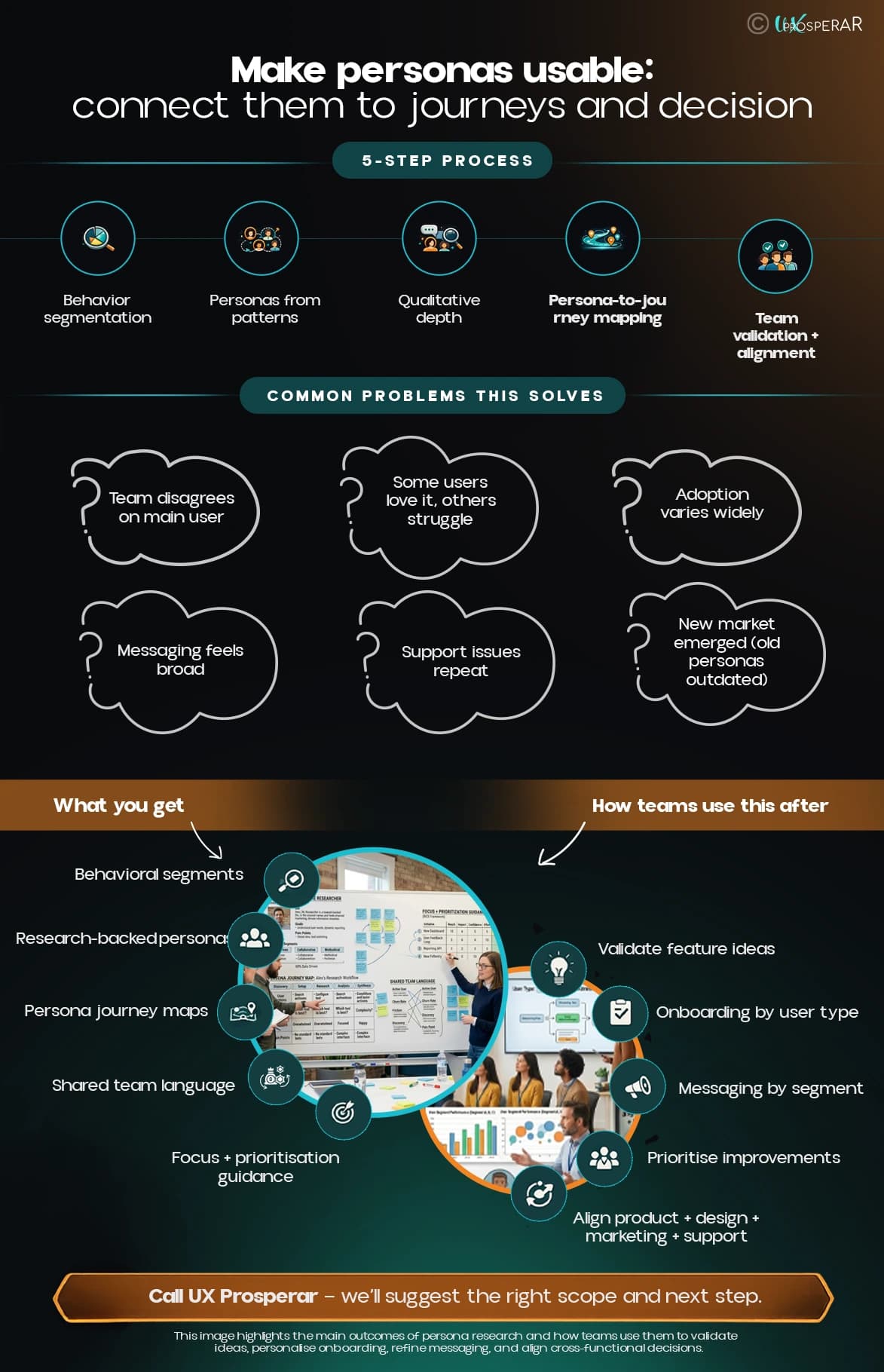
The image highlights the main outcomes of persona research and how team use them to validate ideas, personalise onboarding, refine messages, and align cross-functional decisions
Common problems this study helps solve
This study is useful if you recognise any of these situations:
- Your team disagrees on who the main user is
- Features work well for some users but confuse others
- Engagement or adoption varies across the user base
- Marketing messages feel broad and unfocused
- Support issues repeat but are hard to categorise
- A new market or use case has emerged but old personas are still driving decisions
What you get out of it
The goal is clarity, not documentation for its own sake.
You can expect outcomes such as:
- Clear behavioural segments that explain differences in user needs
- Personas grounded in real goals, motivations, and barriers
- Persona journey maps that show how experiences differ across segments
- Shared language teams can use to prioritise and design
- Direction on which user groups to focus on and why
We keep outputs practical and easy to apply across teams.
How teams typically use this after the study
Teams use persona and segmentation outputs to:
- Review new feature ideas before building
- Design onboarding that fits different user types
- Refine messaging for different segments
- Prioritise improvements based on real user value
- Align product, design, marketing, and support around the same user reality
When personas are research backed, they stay relevant and useful.
Who this is for
This service works for products and services where different users behave differently, which is most cases. It is especially useful when products grow, audiences expand, or new use cases appear.
UX Prosperar works across industries and adapts segmentation to the real shape of your audience, not stereotypes.
Why UX Prosperar
UX Prosperar is a research led and strategic UX and CX design agency based in Dubai. We focus on understanding real user behaviour before proposing solutions.
With 16 plus years of research experience, 1200 plus projects completed, 100 plus brands served, and award recognised research leadership, we bring depth and structure to persona work without overcomplicating it.
Let’s make your users clear
If your teams are guessing who they are designing for, or if your audience has become more complex, a Segmentation and Persona Mapping Study will bring clarity and confidence.
Call UX Prosperar to discuss your product and audience. We will suggest the right scope and next step.