

User Acceptance Testing Services & Quality Testing
This image showcases User Acceptance Testing and Quality Testing services focused on validating real user readiness, usability, and product performance.
Ensuring your product is ready for real users, not just internal sign-off
User Acceptance Testing (UAT) and Quality Testing are traditionally the final validation steps before a product is released. At this stage, development teams and stakeholders verify that features work as specified, flows complete successfully, and the system is technically ready to go live.
In most organisations, UAT focuses on confirming that:
- requirements have been met
- critical flows complete without errors
- edge cases are handled
- nothing blocks release
Products often pass these checks and still struggle the moment real users arrive.
At UX Prosperar, User Acceptance Testing and Quality Testing are treated as experience readiness validation, not just release approval.
How User Acceptance Testing is traditionally conducted
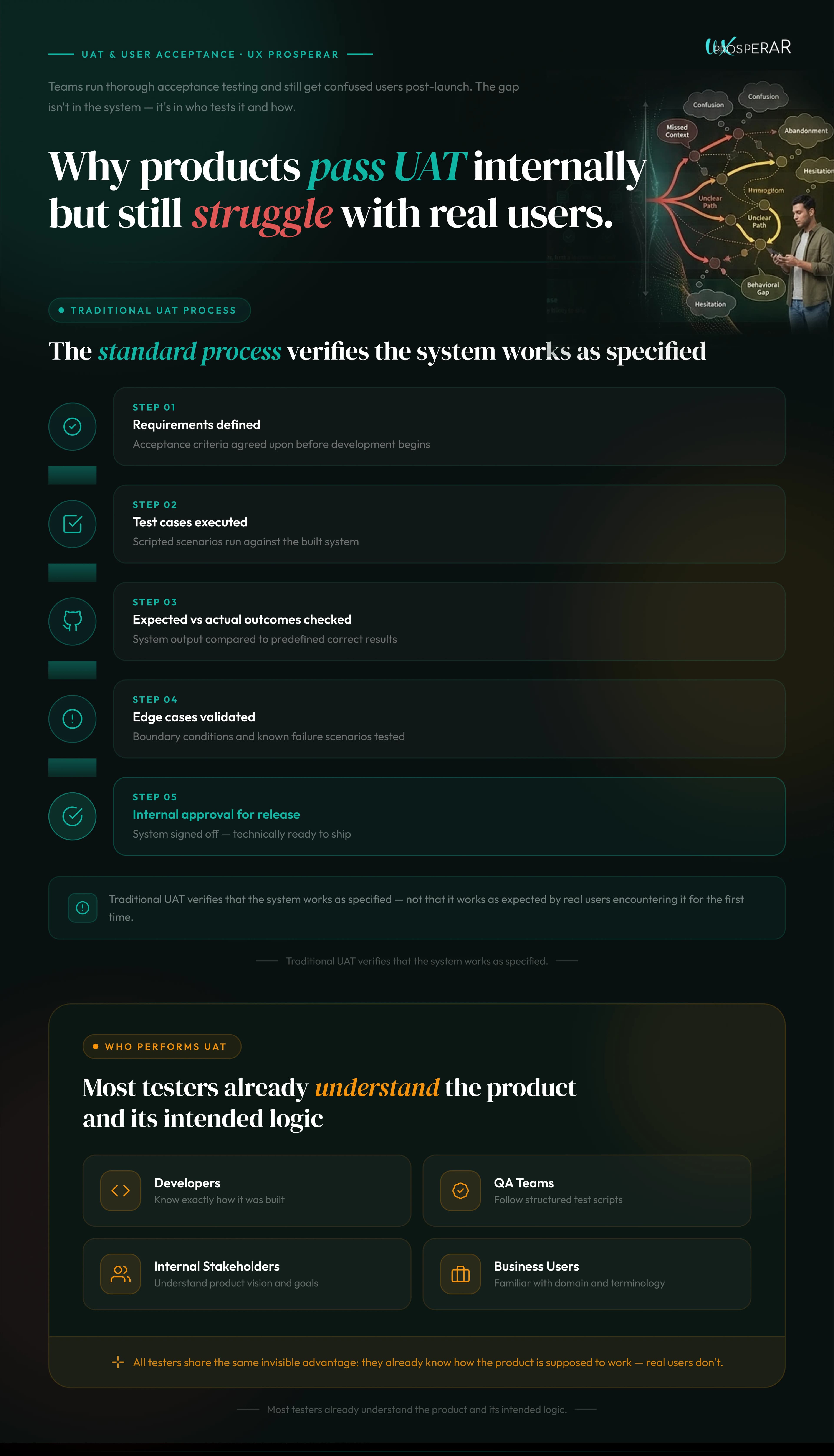
This image showcases why products pass internal UAT processes yet still struggle with real users, highlighting gaps between testing logic and user behavior.
In a typical setup, UAT and Quality Testing are handled by:
- developers
- QA teams
- internal stakeholders or business users
Testing usually involves:
- executing predefined test cases
- validating expected vs actual outcomes
- confirming data accuracy
- checking error handling
This process is essential. It ensures the system works as intended.
However, traditional UAT often relies on:
- internal users who already understand the product
- stakeholders who know the business logic
- testers who follow scripts rather than natural behaviour
As a result, products can pass UAT while still failing on:
- clarity
- confidence
- ease of use
- real-world decision-making
Where traditional UAT breaks down
User acceptance issues usually appear when:
- users don’t know what to do next
- feedback is easy to miss
- errors explain what failed, but not how to recover
- flows technically work but feel risky or confusing
For example, a form may validate correctly, but if error messages appear far from the field in question, users feel stuck.
From a QA point of view, the test passes.
From a user point of view, acceptance fails.
This is the gap UX Prosperar addresses.
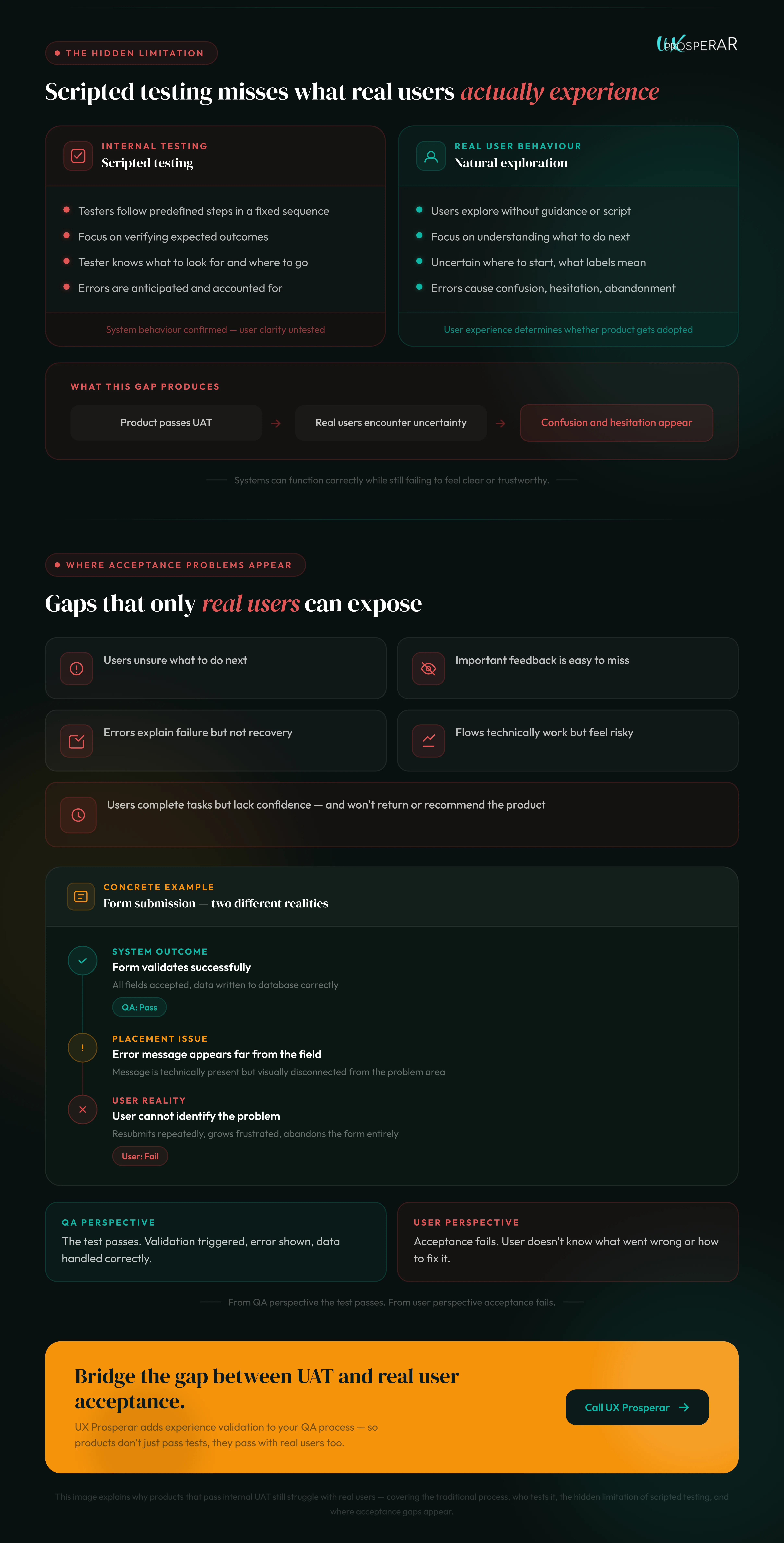
This image explains why products that pass internal UAT still struggle with real users - covering the traditional process, who tests it, the hidden limitations of scripted testing, and where acceptance gaps appear.
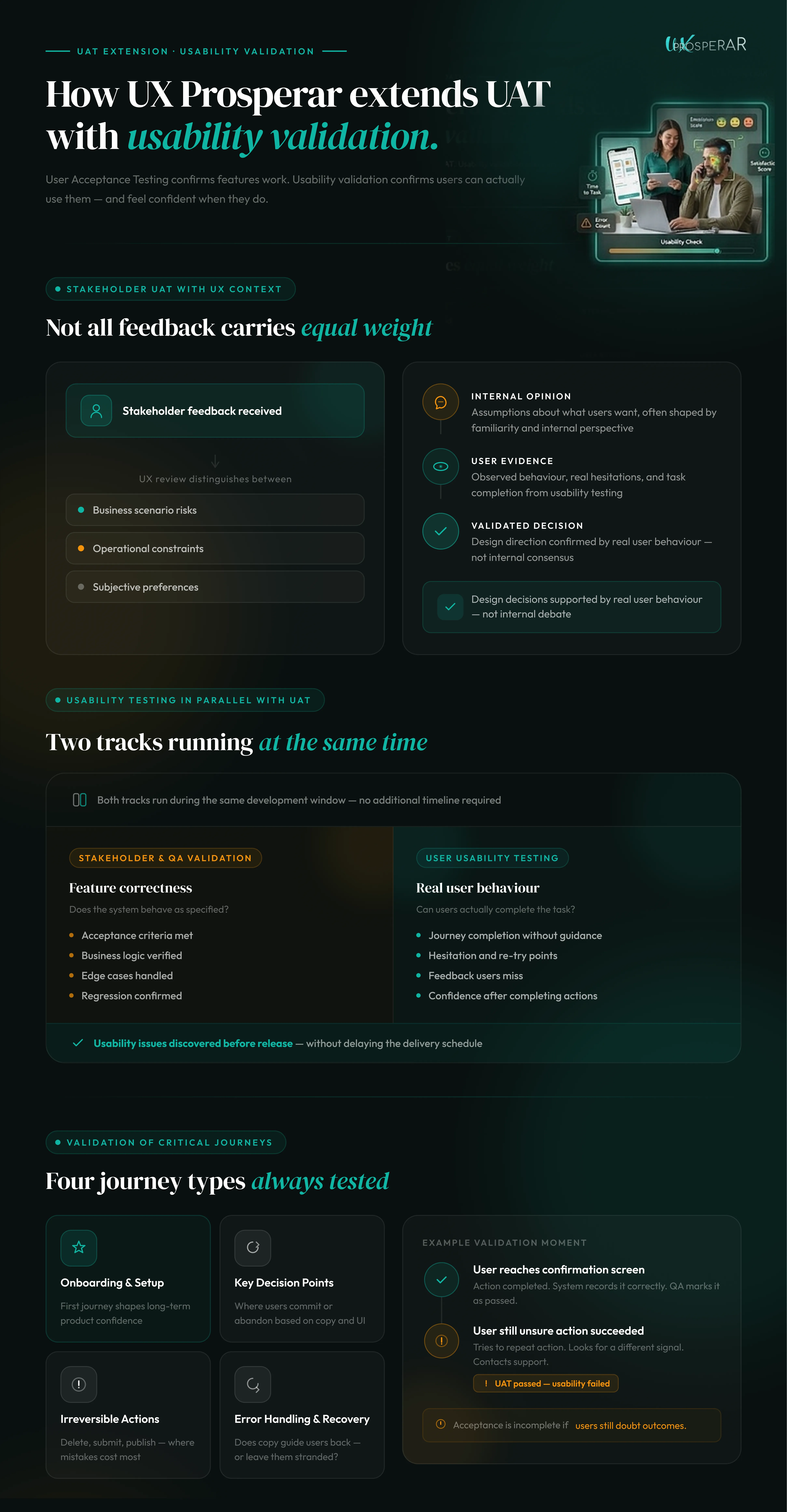
This image showcases how UX Prosperar extends UAT with usability validation, combining real user behavior insights with functional testing accuracy.
How UX Prosperar approaches User Acceptance & Quality Testing differently
UX Prosperar does not replace traditional UAT. We extend it.
Our approach runs alongside developer- and stakeholder-led testing, adding usability-led validation where acceptance usually breaks down.
1. Stakeholder UAT, strengthened with UX context
Stakeholder feedback during UAT is extremely valuable. It often surfaces:
- missing business scenarios
- edge cases
- operational constraints
- compliance concerns
However, stakeholder UAT also introduces:
- subjective opinions
- personal preferences
- assumptions based on internal knowledge
UX Prosperar helps teams distinguish between:
- feedback that reveals real usability risk
- feedback that reflects opinion rather than user behaviour
Where opinions conflict with design decisions, we use user evidence to explain:
- why certain flows were designed a specific way
- what behaviour the design is supporting
- what would actually confuse or slow users down
This prevents products from being reshaped purely by internal preference.
2. Usability testing in parallel with UAT
While stakeholders and QA teams validate correctness, UX Prosperar runs focused usability testing with:
- representative end users
- partners
- staff or operational users
- mixed user types, depending on the product
This testing looks at:
- whether users can complete key journeys without guidance
- where they hesitate or second-guess
- what feedback they miss or misunderstand
- how confident they feel after completing tasks
This ensures usability issues are identified before release, not after support tickets start.
3.Validating critical journeys, not just screens
UX Prosperar focuses acceptance testing on:
- onboarding and setup
- key decision points
- irreversible actions
- error handling and recovery
For example, if users reach a confirmation screen and still wonder whether an action worked, acceptance has not been met, even if the system processed the request correctly.
4. Quality testing focused on clarity and confidence
Quality issues often hide in small moments:
- unclear loading states
- subtle feedback that users don’t notice
- buttons that change state without reassurance
- messages that disappear too quickly
These details directly affect:
- trust
- speed
- error rates
- support volume
UX Prosperar treats these as acceptance criteria, not cosmetic polish.
5. Early post-release acceptance validation
Even strong pre-release testing cannot replicate real-world conditions.
This service can extend into early live usage to validate:
- behaviour at scale
- confusion caused by real environments
- issues that appear only with multitasking, interruptions, or poor connectivity
This allows teams to correct acceptance gaps before they become entrenched behaviour.
Everyday product issues this service helps catch
“It passed QA, but users are still confused.”
“Support tickets mention uncertainty, not errors.”
“Stakeholders disagree on what should change.”
“Fixes keep introducing new confusion.”
“The product works, but users don’t trust it.”
These are acceptance problems, not development failures.
What this service is, and what it is not
This service is
- User Acceptance Testing with real users involved
- Quality testing focused on usability, clarity, and trust
- Stakeholder feedback balanced with user evidence
- Pre-release and early post-release validation
This service is not
- Automated testing or regression testing
- Performance or load testing
- A replacement for QA or development teams
- A guarantee of zero post-launch issues
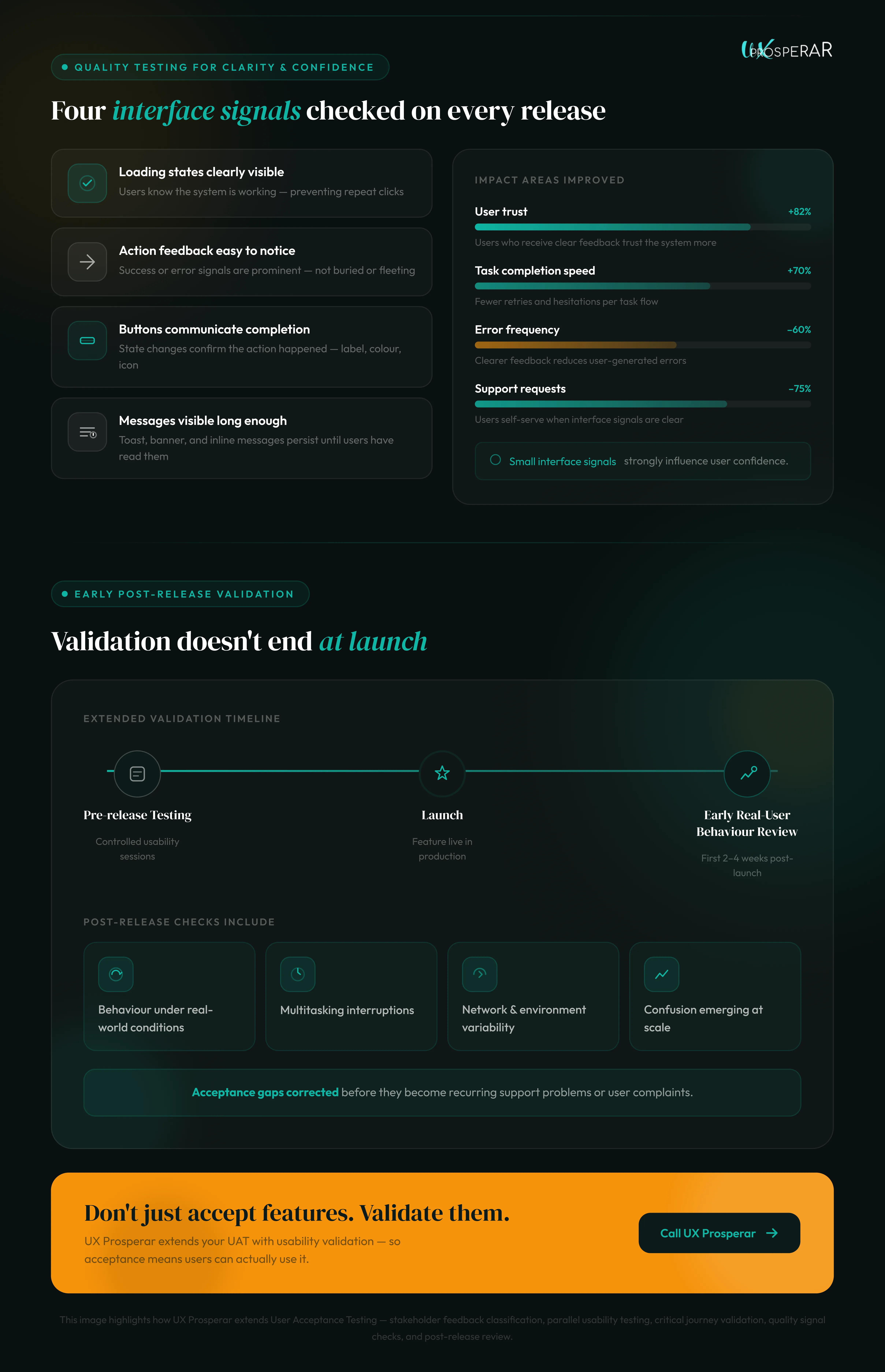
This image highlights how UX Prosperar extends Users Acceptance Testing - stakeholder feedback classification, parallel usability testing, critical journey validation, quality signal checks, and post-release review.
Who this service is designed for
User Acceptance Testing Services & Quality Testing are a strong fit when:
- a product is approaching release or major update
- past launches caused user confusion
- stakeholder feedback is conflicting
- teams want confidence beyond internal sign-off
This applies to startups, scale-ups, and enterprise teams.
Why UX Prosperar
UX Prosperar brings research-led UX and CX design judgement into one of the most critical decisions in product development: is this ready for users?
With 16+ years of experience, 1200+ projects, and 100+ brands, we help teams separate:
- opinion from evidence
- correctness from confidence
- internal approval from real acceptance
So products don’t just pass UAT, they work for users.
Talk to UX Prosperar
If you are preparing for release or seeing signs of confusion after launch, User Acceptance Testing Services & Quality Testing can help you understand where acceptance truly stands.
Reach out to UX Prosperar. Share what you’re releasing and who it’s for. We’ll help define the right scope and next step.